


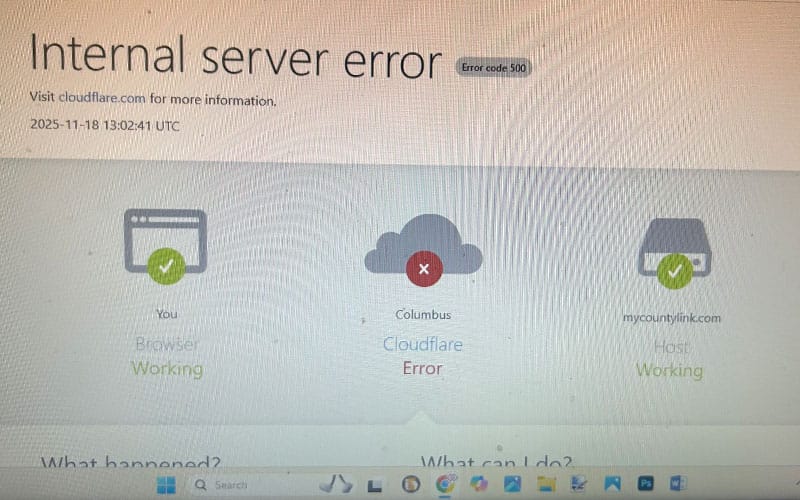
On Tuesday, November 18, 2025, early in the morning Eastern Time (~6:40 a.m ET), Cloudflare — the internet-infrastructure firm that routes and secures around 20 % of all web traffic — began experiencing a serious disruption.
-
Cloudflare reported an internal service degradation.
-
Their network was hit by a “spike in unusual traffic” starting around 11:20 UTC (6:20 a.m ET) which triggered cascading failures.
-
Error 500 (“Internal Server Error”) messages proliferated across many websites and services relying on Cloudflare’s network.
-
By about 9:42 a.m ET (≈ 14:42 UTC) Cloudflare declared the incident resolved, but warned that residual issues might persist.
-
Cloudflare’s CTO Dane Knecht confirmed the issue was not a cyber-attack.
Services & Users Impacted
Because Cloudflare’s infrastructure is deeply embedded in a large number of websites and apps, the outage affected a broad swath of the internet:
-
Major social platforms like X (formerly Twitter) went offline or displayed error messages.
-
AI platforms, including ChatGPT by OpenAI, were disrupted.
-
Other impacted services: Spotify, Uber / Uber Eats, Canva, and transit-system apps such as those of NJ Transit.
-
Government websites (e.g., MI5, Financial Conduct Authority) and major retailers reported errors.
-
Even monitoring services like Downdetector — which itself relies on infrastructure — logged elevated error reports and, in some cases, was inaccessible.
Why This Matters (Especially for Local Businesses & Tech-Users)
-
Infrastructure dependency risk: The outage illustrates how many websites and services — from big platforms to smaller agencies — share underlying dependencies (CDNs, security & routing services) like Cloudflare. When those foundational components go down, even “unrelated” services can break.
-
Business operations impact: For companies relying on web access, cloud tools, SaaS apps, or daily workflow platforms, the outage underscores how non-operational hours in the morning (especially during business hours) can cascade into lost productivity, service disruptions, and reputational risk.
-
Local SEO / Web presence concerns: For websites of local businesses (e.g., shops, service providers, community news sites) that use Cloudflare’s services (e.g., DNS, caching, bot-protection), downtime may reduce search engine visibility, customer access, and trust — even temporarily.
-
Resilience & contingency planning: For content-creators, web-admins, digital marketers (like yourself), this is a reminder to assess backup access, monitor dependencies, and communicate to users when major third-party infrastructure hiccups happen.
What Caused It & What’s Next
-
As per Cloudflare’s public updates, the trigger was a “configuration file … automatically generated to manage threat traffic [which] grew beyond an expected size of entries and triggered a crash in the software system that handles traffic for a number of Cloudflare’s services.”
-
There is currently no indication of a malicious cyberattack.
-
Cloudflare has committed to a post-mortem and to improving its controls and monitoring. Some residual errors (dashboard access, login flows) may take longer to fully normalize.
-
For businesses and site-owners, this means reviewing:
-
whether your site uses major infrastructure providers (CDN, DNS, edge-security) and how single points of failure might exist
-
monitoring plans to detect third-party provider disruptions
-
communication templates for when user access to your website/app is impacted due to third-party dependencies
-
Immediate Steps for Affected Users & Businesses
-
If you manage a website or online service, check whether your site relies on Cloudflare services (DNS, CDN, security) and confirm whether the incident affected you (server logs, error rates, user complaints).
-
Review your incident response plan: do you have alternative access routes, content-delivery fallbacks, or notifications to users/customers when infrastructure goes down?
-
Communicate clearly: if your service was disrupted and your customers were impacted, issue a brief statement explaining the outage, noting it was due to external infrastructure, and what you’re doing to help prevent repeat incidents.
-
For local and community-based digital platforms (news sites, service providers, events): consider adding fallback modes (e.g., cached landing pages, alternative DNS) and verifying your monitoring/alerts cover “third-party infrastructure failure” not just your own servers.
-
Internal review: after the dust settles, map out your provider dependencies (CDNs, Web-app firewalls, DDoS mitigation, cloud functions) and identify where you might reduce single points of failure or add redundant backup options.
Why Local-Digital Content Creators (Like You) Should Care
Given your interest and engagement in local SEO, digital marketing, and website content for community businesses, this incident is a timely reminder that even if you do everything right (SEO, content, user experience) — your foundation still relies on infrastructure you don’t control. When a major service provider stumbles:
-
Your site might load slowly or not at all for some users.
-
Search engines may detect downtime and indexing/re-crawling may be impacted.
-
Your clients (local businesses) may ask: “Why couldn’t my customers access my site this morning?” — and you’ll want to have an explanation beyond “the internet was broken.”
-
You might want to include statements in your client-deliverables about infrastructure resilience, contingency planning, uptime monitoring, etc.