

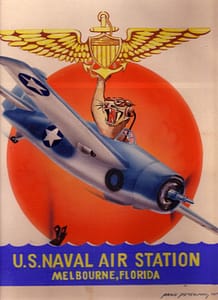
The orders we received upon finishing at Pensacola directed us to report to Naval Air Station Melbourne. A week ago we’d all earned the coveted wings of gold and were newly minted Naval Aviators. When we arrived at Melbourne and reported, we were given four days of liberty since we’d had no time off at Pensacola. The USO ran a bus on weekends from the Air Station to the beach, so Ted Landrum and I checked out fishing gear from the base Special Services and hopped the bus to the beach for a little surf fishing.
I could see the blues schooling in the surf just off Indialantic Beach. However, I wasn’t getting any strikes on my Yellow Bluefish Bomb plug. I looked to my right and saw Ted Landrum landing yet another fish.
“What are you using, Ted? That’s your third fish, and I haven’t even gotten any strikes.”
“Try a hammered silver spoon, Lou. They seem to be hitting on shiny things today.”
I reeled in my plug and walked a few steps back to the tackle box. Rummaging through the box, I picked a heavy silver spoon. As I was tying it on my line, I looked up and noticed three girls walking down the beach, laughing and talking, splashing through shallow water as the surf broke and flowed back to the ocean. One of the girls caught my eye—they were all pretty, but she was absolutely gorgeous.
“Catching anything?” the beauty asked.
“I wish,” I said, grinning and hoping she wouldn’t catch the double entendre.
“Maybe you’re using the wrong bait,” she replied, laughing. “Your buddy seems to be doing pretty well.”
Landrum made another long cast into the surf. As he reeled the lure in, he glanced at me and the girls and said, “Maybe he’s fishing for the wrong kind of fish.”
“Maybe. Keep trying, friend,” the gorgeous one said to me. “Perhaps you’ll hook a mermaid.” All three girls giggled as they continued past us, walking down the beach.
I wound up catching four nice blues by the end of the afternoon. We threw them all back, as our barracks was not equipped to cook fish. Soon it was time to take the bus back to the base and get cleaned up. Landrum and I were headed for a blind date arranged by a fellow named Joe Angel, a civilian who lived in Melbourne and worked at the base. We met him at the gate in our best khakis, piled in his car, and headed for the Melbourne Country Club. We were supposed to meet his girlfriend there and two girls she had roped into a triple blind date.
“Oh! It’s you!” one of the girls exclaimed when we joined them at their table. It was the pretty girl I’d seen on the beach. “So did you catch any fish?” she asked with just the slightest hint of sassiness.
“As a matter of fact, Miss, I did—four of them.”
“You two know each other?” Joe asked, surprised.
“No, not really. I just ran into the young lady on the beach earlier today,” I replied. Turning to the girl, I said, “But I really would like to know your name, Miss. I’m Lewis Cobb, and my friend here is Ted Landrum.”
“Pleased to meet you, Lewis. I’m Helen Lea,” said the girl, “and this is my friend Priscilla Mullin. You must already know Joe’s girlfriend, Susan.”
“Actually, no, we’ve never met,” said Ted. “Pleased to meet you three girls.”
We sat down at the table and picked up the menus. “Wait, people,” Joe said, “seems to me the first order of business is to decide who is with who tonight.”
After we all proposed several ideas, Priscilla Mullin suggested, “Well, maybe the tallest girl should be with the tallest man. That makes as much sense as anything.”
I smiled. “That would put you, Miss Lea, with me, I believe.” Which is exactly what I was hoping for, as I was smitten by Helen’s looks and the fact that her little bit of teasing revealed she was no shrinking violet. I liked her spunk.
By the end of the evening I was thinking, this is the girl I want to marry. Over the next two weeks we went out together five more times. When it was time for her to return home to Columbia, South Carolina, I borrowed Joe’s car and took her to the bus station. Her aunt met us there and we waited for the bus together. When Helen excused herself to use the restroom, Aunt Gloria leaned toward me and said quietly, “Be careful, Lewis. Do you know how old she is?”
“No. I’m guessing maybe nineteen?” She certainly carried herself with that level of maturity.
“No, son, she’s fifteen.”
“What!?”
I was so disappointed. What I had thought was headed toward a serious relationship now appeared to be little more than a summertime-at-the-beach fling. But at least we did trade addresses. Time would tell.
**********
Naval Air Station Melbourne, known in navy parlance as Operational Training Unit No. 2 (OTU2), was tasked with honing our skills as fighter pilots, particularly concerning gunnery. It was also here that we got our first taste of the F4F Grumman Wildcat, which was a very substantial step up from the SNJ trainers we’d been flying. By way of comparison, the SNJ powerplant produced 550 hp., whereas the Wildcat had 1200 horses under the hood. Top speed in the SNJ was 205 mph with a ceiling of 21,500 feet; in the Wildcat it was 331 mph and a ceiling of 39,500 feet. Most importantly, the SNJ had only two forward-firing machine guns, the Wildcat had four and in later variants, six.
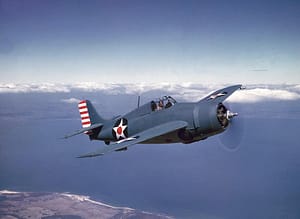
“Gentlemen,” Lieutenant Trowbridge began, “welcome to Melbourne. While at this Air Station you will get to know the F4F-3 Wildcat better than you know your momma and daddy. There’s a stack of brand-new F4F operation manuals on the table near the door. Each of you take one. Those manuals do not leave the base, by the way. You are to read and become very familiar with the entire manual. Furthermore, you are to memorize all of the relevant specifications of the aircraft. Next week I will quiz you on them; in two weeks you’ll have a full test on them. Any grade below eighty percent will be a failing grade. Do NOT fail.
“Couple of words of warning about the Wildcat. One of the design flaws is that the landing gear is too close together which makes ground-looping a real problem. You have to be very careful in a cross-wind landing. It’s not as much of a problem on an actual carrier landing because the wind is coming right over the nose of the carrier—but on a field carrier landing you will have cross-winds from time to time. Beware the ground loop.
“Second, to lift or lower the landing gear you must hand-crank it up or down. Depending on the exact model you’re flying, the F4F-3 or F4F-3A, it takes between twenty-eight and thirty turns of the crank to raise or lower the gear and lock it in position. You need to make sure it is locked, up or down, before you turn loose of the crank. If you let go of the crank while the gear is unlocked it will spin around like lightning and crack you in the hand. We’ve had a few unwary pilots land with a broken hand because the handle got away from them.
“I know that hand-cranking the gear is a pain in the butt, but get used to doing it. It must become second nature for you, so you don’t even have to think about it. When you’re taking off from a carrier you’ve got a lot of other far more critical things to be thinking about—retracting your flaps, watching your airspeed, keeping the aircraft aloft and out of the drink—especially if it was an under-speed takeoff. So cranking the gear needs to become purely reflexive, a mindless habit so you can focus your brain on flying the airplane.
“Rumor has it that Grumman has fixed both landing gear issues in the F6F Hellcat, but we have not received any of those yet, so here at Melbourne you’ll be flying Wildcats.”
**********
The first order of business at Melbourne was to demonstrate that we actually knew how to fly. We had to prove that NAS Pensacola was not graduating problem pilots hoping that Melbourne would fix them. So on Saturday, June 12, I climbed into the cockpit of my old friend, the SNJ-4 trainer. Hoisting himself into the second seat was Lieutenant W. J. Du Bois.
Navy pilot training during the war was generally conducted by men who had survived at least one deployment in a combat theater. Du Bois had flown in the battle of Midway in Yorktown’s fighter squadron, VF-3, and had splashed three Zeroes. While the Yorktown and its air group acquitted itself well in that scrap, the Japanese got their revenge on the carrier. As the battle of Midway wound down several Jap dive bombers penetrated the Yorktown’s CAP screen and put several bombs through its flight deck all the way into the hangar deck, crippling the carrier. Successful salvage efforts were under way until she was sucker punched by a Jap sub while under tow back to Pearl. That finished the poor girl off.
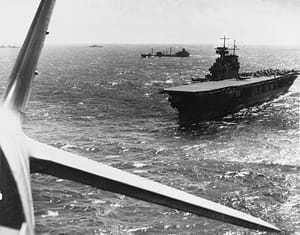
Du Bois found himself attached to the Enterprise (CV-6) for the ride back to Pearl since his home base was now resting peacefully under three miles of Pacific Ocean. For those of us at NAS Melbourne, Du Bois was a celebrity on the order of Frank Sinatra. Whatever he wanted to teach us, we were all ears. Whatever luck the man had, we wanted a piece of it.
I passed the check ride with no hiccups. Two days later I checked out in another SNJ on an instrument flight. No problem. It was finally time for my introduction to a real fighter aircraft. On June 15th, 1943, I climbed into the cockpit of a Grumman F4F-3 Wildcat for the first of thirty hours I would log in June, followed by eighty more in July.
**********
It was a rare day off with no scheduled flights or lectures. Thunderheads were boiling up on the western horizon—a hot, humid July day in central Florida. Most of us were in our skivvies, just trying to stay cool. The whole cadre was lying around the barracks, exhausted from the aggressive tempo of training. Some of the guys were sleeping, some were playing cards, and some were engaged in the time-honored privilege of military men: griping.
“You know, Lou, it would be much easier if we just dispensed with the game and you forked over all your cash now,” Landrum chuckled, as he kicked another one of my pieces to the bar. “You know I’m gonna take you to the cleaners.”
“We’ll see,” I muttered. I was busy losing last month’s pay, dollar by dollar, to Ted Landrum on the Acey Deucey board. In addition to being my best friend, Ted was the undisputed Acey Deucey champion of the squadron.
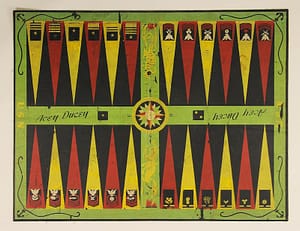
It was my roll. I kissed the dice and urged, “Be there!” as I tossed them onto the blanket. Wonder of wonders, they came up Ace Duce, one and two. “ACEY doooocy!” I exulted. Both the one and two positions on the board were available, so I entered two of my men onto the board. I rolled one of the die for my doubles move and it came up with a four, which kicked a pair of Ted’s men back to the bar. I grinned maliciously. “Let not him that putteth on his armor boast like him who taketh it off.”
As he grabbed the dice, Landrum snorted, “Where’d that bit of wisdom come from?”
I shrugged, “Somewhere in the Bible, I think. The football coach in Bradenton used to say it when there was too much trash talk before a game.”
“Lou, give it up. You know he’s gonna pick your pocket. He got all my cash last night,” said Rocky Aldridge. He was laying on his bunk, cap over his eyes. “By the way, Landrum, how many hours have you logged in the cockpit this month?”
“Forty-three.”
“How ‘bout you, Cobb?”
“Forty-five.”
“I’ve already got forty-six hours in the cockpit this month, and it’s only the eighteenth,” John Campbell moaned.
“Yeah, well, you’d only have twenty-six if you’d just learn how to land that dang thing, Campbell,” laughed Aldridge, pulling the cap off his eyes and sitting up. “Your flight hours are filled up with go-arounds. Twice it was because you forgot to lower the gear.”
“Maybe so, Rocky, but I sure smoked your butt on gunnery yesterday,” Campbell shot back. And he had—Campbell had scored a squadron high yesterday with twenty-two hits on target. Rocky hadn’t connected but once with the target sleeve. “You might make a slick landing, but you can’t hit the broad side of a barn.”
“Uhh, yeah, let’s change the subject,” Rocky said.
“Darn right, I want to talk about the excessive flight hours. Are they trying to kill us? It can’t be safe,” complained Bob Wright, “when we’re all flying exhausted. Someone’s bound to make a fatal mistake.”
“Attention!” called Campbell, as Lieutenant Du Bois stepped into the barracks.
“No, as you were, gentlemen,” Du Bois said. “I was standing outside the window, eavesdropping. So, who’s concerned that we’re trying to kill you guys with unsafe, excessive flight hours?”
There was silence for a minute, then Wright admitted, “That was me, sir.”
Du Bois nodded. “Gentlemen, listen to me and learn. A Yorktown-class carrier carries one to two squadrons of fighters. That’s eighteen fighters, or if you’re lucky, maybe thirty-six. Those fighters are used for combat air patrol, providing protection for the task group. They are also used to provide escort and air cover when the dive bombers and torpedo bombers are sent on a strike. And they are also sent on fighter-sweeps and strikes themselves. All things considered, those fighter pilots are among the busiest people aboard ship. Their operational tempo is unrelenting.
“So no, Ensign Wright, we are not trying to kill you. We are trying to see who can handle the pressure of constant operations. When the carrier is in theater, every one of those fighters is essential—as are their pilots. We are not going to put you on the boat unless we’re sure you aren’t going to fall apart under the pressure. The pace of operations you’re experiencing right now approaches the operational tempo you will encounter on the ship. The question for each of you is, can you hack it?
“Questions, anyone? No?
“Okay, one more thing. Toward the end of the month I’ll need volunteers to ferry four Wildcats from Quonset Point. If you’re interested, put your name on the list in the squadron office. In a week, I’ll pick four men from the list for that mission.”
**********
The flying we were doing now was to sharpen skills we already had: gunnery, bombing, instrument flight, night flights, navigation. Most days we put at least three hours in the cockpit and many days four or more.
My favorite kind of flight was tactical—anti-submarine patrols. German U-boat activity picked up significantly right after Pearl Harbor. The hottest part of the activity near the American mainland was on the Atlantic Seaboard from the Carolinas northward (397 ships sunk in ‘42), but it was no picnic along the south coast. In 1942, U-boats sank five ships not fifty miles from NAS Melbourne, some within sight of the coast.
The Wildcat was not really designed for anti-submarine warfare, but it wasn’t toothless. We could strafe or drop our bomb load on enemy submarines. We’d all heard the story of VMF-211, and how the marines on Wake Island in 1941 had destroyed a Jap sub with 100-pound bombs dropped from Wildcats.
Our instructors at NAS Melbourne trained us to fly anti-submarine patrols off the coast of Florida, fully armed and weapons free. These were not just training flights—they were actual patrols—the first truly tactical flights of our careers. We were taught to look not only for surfaced submarines, but for the feather in the water caused by moving submarines at periscope or snorkel depth. If we located a submarine we were free to attack it. Even though I never spotted a sub, I felt like I was doing something to protect my country. Our squadron was proud of the fact that during our time at Melbourne, no shipping had been lost off the east coast of Florida. I’d like to think our patrols had something to do with that.
**********
“Did you check out the ferry list in the squadron office?” Aldridge asked as I set my tray down next to his in the mess hall.
“Honestly, no. After I put my name on the list a week ago, I forgot about it. Why?”
“Our entire division was selected to go to Quonset Point and ferry Wildcats back to Melbourne. All four of us,” he said, looking at Ted Landrum and Bob Wright sitting across the table.
“That’s swell!” I said. “That will be fun. When do we leave?”
“Takeoff is 0500, Monday morning. I’ve been tasked to lead one section, and you, Lou, lead the other. Wright is my wing man, Landrum is yours. I’m the overall division leader,” Aldridge said.
Two days later Lieutenant Du Bois called the four of us into the pilot’s ready room for a briefing. He passed out flimsies containing our orders.
“Gentlemen, this will be your first mission in which you will be acting as naval officers independently of superior officers. The mission is very simple: go to NAS Quonset Point, sign out the four Wildcats—the Bureau numbers are on your orders—and fly them here. Report to me immediately upon your return.
“Even though you are at the very bottom of the greasy totem pole of commissioned naval officers, you are nonetheless officers—ensigns—in the US Navy. You don’t need baby sitters. You have all the training you need. You have all the authorization you need. Go and do the job.”
“Sir, if we have any engine trouble what should we do?” asked Bob Wright.
“You’re officers, you figure it out. Any more questions? No? Okay, there’s a C-47 headed for Quonset Point on Monday. It’s making a brief stopover at Jax before continuing on north. Takeoff is 0500 hours. Make sure you’re on that aircraft with your flight bags.”
Sunday night I was too excited to sleep. I felt like this was somehow a big step in my career as a naval officer. In retrospect it wasn’t that big of a deal, but at the time it felt very big. Perhaps I can explain this way: the successful accomplishment of this mission would not add much of a feather to my cap, but a failure could be disastrous to my career. I was determined not to fail.
Upon landing at Quonset Point we reported immediately to the command duty officer. He presented our orders requisitioning the Wildcats to the base XO, who approved it and sent on an order to the operations team to have the designated aircraft available to us, parked on the flight line at 0700 Tuesday morning.
**********
The activity around the airfield seemed chaotic, with aircraft constantly taking off, landing, taxiing. Quonset Point was by far the busiest airfield I’d flown out of to date, it was like a city at rush hour. Everywhere I looked something was in motion. Because of the volume, we were not able to takeoff in formation. Our planned rendezvous point was at 5000 feet, several miles west of the airport. We had dubbed our mission call-sign “Falcon.” Rocky was Falcon-one, Bob Wright was Falcon-two, I was Falcon-three, and Ted Lundrum was Falcon-four.
“Tower, Falcon-three requesting taxi”
“Falcon-three, taxi to runway three-four, hold short.”
“Tower, roger, taxi to runway three-four, hold short, Falcon-three.” I taxied to the holding point, stopping short of the apron. Looking to my right I saw a B-26 Marauder coming in for a landing. After the bomber’s rollout, the tower contacted me: “Falcon-three, winds at three-one-zero at one-five knots, runway three-four cleared for takeoff.”
“Roger, Tower, cleared for takeoff, runway three-four, Falcon-three.”
I pushed the throttle forward and was soon airborne. We assembled at 5000 feet, then set a course that would take us over Lady Liberty on Liberty Island. Descending to 2000 feet we made a couple of lazy sight-seeing circles over the Big Apple before proceeding south. I was very proud of the fact that we kept a very tight formation as a division throughout the whole time.
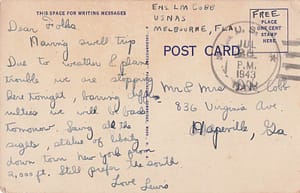
Cruising at about one-hundred-fifty miles per hour, we were over Tom’s River when trouble hit: “Falcon-one, this is Falcon-two, I’ve got a problem.”
“Go ahead, Bob, what’s up?”
“Something is leaking, Rocky. I’ve got a clear liquid spraying on the windscreen, and I think it’s Avgas. At least, I can smell gas.”
“Oh, that’s not good. What’s your fuel situation?”
“I’ve got about thirty gallons left in the main tank.”
“Falcon-one, this is Falcon-three. Grumman released a maintenance bulletin last week concerning a fix for fuel-line leakage. Maybe Bob’s ship hasn’t had the fix.”
“Roger that, Lou. Falcon-two, standby… Okay, we are roughly seventy-miles from Wildwood NAS. Can you make that, Bob?”
“Affirmative, Falcon-one. As long as this thing doesn’t catch on fire.”
“First hint of smoke, Bob, you bail out. Got it?”
Rocky Aldridge radioed ahead, asking for a straight in approach for Falcon-two, wanting to get Bob Wright on the ground as soon as possible. The rest of us entered the regular landing pattern, and thirty minutes later we were all on the ground, taxiing to the flight line.
The aircraft mechanics found the problem and fixed Bob’s ship in short order. It was indeed the problem indicated by the Grumman bulletin, so the mechanics checked our other three ships to make sure the problem had been corrected in them as well.
While we were waiting for the repairs, the base meteorologist posted a bulletin warning of several lines of developing thunderstorms coming up the coast. Given that it was now later in the day, the four of us decided to spend the night at Wildwood.
The next day we logged about five hours, hopping from Wildwood to NAS Norfolk, then Charleston, and finally landing at NAS Jacksonville. The next morning we flew a short hop to Melbourne, completing the mission. We received a ‘well done’ from Lieutenant Du Bois.
My time at NAS Melbourne and this final segment of training was rapidly coming to a close. I logged almost eighty-two hours in the cockpit in July, then three more hours the first two days of August. This chapter of training was complete.
**********
Carrier-Qualification, or CarQual in navy-speak, was the final hurdle to becoming a carrier-certified naval fighter pilot. To be qualified to land on a carrier, a naval aviator must make eight successful carrier landings. If that sounds a little contradictory, well, I suppose it is. It’s like saying you can’t land on an aircraft carrier until after you’ve landed on an aircraft carrier. Like some wag once said, the only way to do something right the first time is to have done it once before.
The Navy’s solution to this conundrum was “field carrier landing practice,” or FCLP. A traditional, land-based runway was painted to resemble a carrier deck, complete with actual, working arresting cables. It wasn’t moving forward, and it wasn’t pitching up and down vertically, so it was a good way to safely practice landing on a postage stamp. I did my requisite FCLP landings on August 7, without much trouble. While it helped, it could not completely prepare me for the real McCoy, which came in Chicago four days later, on August 11.
Really? They want me to land on that? There’s not enough room on that deck for two picnic tables and a beach umbrella! From three hundred feet AGL (Above Ground Level) on the upwind leg of the landing pattern, the deck of the USS Sable looked tiny as she steamed into the wind on Lake Michigan. Being that the ship was underway, she was surrounded by water fore and aft, port and starboard. Perhaps that is an obvious observation, but it makes the prospect of landing on that miniscule strip a white-knuckle affair. There’s no friendly grassy shoulder to cover your mistake if you happened to miss the center line by a bit, or catch a random cross-wind gust.
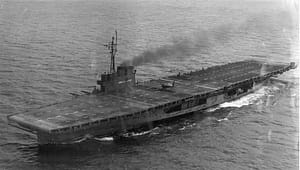
I was well into my upwind leg when I suddenly remembered I’d not dropped the tailhook. Five seconds later I banked left in accord with the landing pattern, and it was time to crank the landing gear down—thankfully it locked in the down position. Abeam the Sable by about 1200 yards on the final downwind leg, I checked my altitude—two-fifty AGL, too high. C’mon Lou, you can do this. Throttling back a bit, when it was time to turn upwind my altitude was perfect. I was just ten knots above stall speed, and there was the stern of the Sable right where it should be. I was aligned with the center line on the carrier deck perfectly. A few seconds later the Landing Signal Officer (LSO) gave me the cut sign. I throttled back and the Wildcat dropped hard to the deck. My shoulder harness kept me from being thrown into the gun sight as the tailhook caught the third wire, and the Wildcat came to a violent halt. It was a little rough, but the airship and I were safely on the deck with no damage. Only seven landings to go, I thought, as my heart tried to pound through my chest.
My hands were shaking a bit as the deck crew disattached the tailhook from the arresting wire and spotted me for a short-field takeoff. Between the prevailing breeze and the forward motion of the carrier, the wind over the bow was about thirty-five knots. On signal from the deck crew I jammed the throttle forward and the Wildcat began to roll down the short deck. With my heart in my throat I could see I was very rapidly running out of runway. I knew the flight deck was a mere twenty-seven feet above the cold, blue waters of Lake Michigan. It felt like the airship dropped twenty feet when I ran out of deck, but it was probably only five or ten. Concentrating, I banked slightly to the left and nursed the flaps, while cranking up the landing gear. As the Wildcat began to climb, nervousness was replaced by elation. I did it!
The next several landings and takeoffs went better. Inclement weather put an early stop to the exercise, so I didn’t complete my requisite eight carrier landings until the next day. As soon as I cranked up the gear on my final CarQual takeoff, I whooped with joy. I made it! I was now carrier-qualified.
**********
After CarQuals, the Navy granted us a fifteen-day leave. Dad had secured a little cabin on a lake in Florida, so I returned to Florida and had a glorious time fishing, resting, and recouping with my folks. That is, until I developed some kind of problem that required a brief hospital stay. I’d received a letter from Helen Lea complaining that I was not writing often enough, so I used the time in the hospital to catch up on my correspondence.
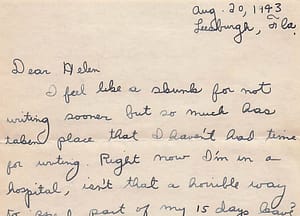
Aug. 20, 1943
Leesburgh, Fla
Dear Helen, I feel like a skunk for not writing sooner but so much has taken place that I hadn’t had time for writing. Right now I’m in a hospital, isn’t that a horrible way to spend part of my 15 days leave? I’ve been sick for two days, with luck I should be OK by tomorrow …
My folks had everything planned for a 10 day vacation on a lake near here, so that accounts for me being back in Florida. We left as soon as I got home. We have a nice cabin on a beautiful lake about 20 miles from Ocala. We have our own boat and motor so about all we do is fish, sleep, and swim. Hard life, eh! I caught 10 bass the other day… All in all I would be having a wonderful time if it wasn’t for this sojourn in the hospital…
I surely did enjoy going with you and I had a swell time every minute of it, mosquitoes and all. I surely hope you will remain just as you are, there are still plenty of fellows who appreciate a girl for being just herself and not what she might try to be.
Oh yes I would definitely like to have a picture of you… Be real sweet and write.
As ever,
Lewis.
**********
I looked at the flimsy in my hand and had a hard time believing I had finally achieved my goal. The desire to serve my country as a naval aviator was born in my dorm room at Georgia Tech on the night of December 7th, 1941, when I heard that Japan attacked Pearl Harbor. As soon as I was old enough, April of ‘42, I joined the US Naval Reserve as an aviation cadet and entered flight training.
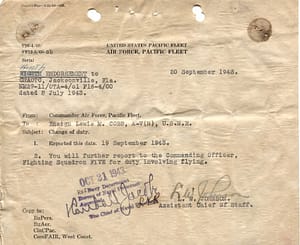
There’s been a lot of water under the bridge since April of 1942. I am now a carrier-qualified US Navy fighter pilot. I am aboard the Santa Fe Superchief passenger train as it races through the night, bound for San Diego. My orders direct me to report to the commanding officer of Fighting Squadron Five (VF-5), ‘for duty involving flying.’ I could not suppress a satisfied smile as I returned the orders to my pocket, leaned back, and fell asleep.