

The cab I caught at the train station dropped me off at the main gate of the San Diego Naval Base. There was a line of traffic entering the base, and the MPs were too distracted to give me the time of day, much less directions. Even though by now I was accustomed to the way the Navy did things, finding my way as a newcomer on a huge base was a bit of a challenge. With a sigh, I shouldered my seabag and started to explore.
It was a very busy, almost chaotic base, resembling an ant hill someone had kicked over. The manic tempo of the installation actually made sense when you figure that San Diego was one of the principal naval bases supplying the war in the Pacific. In any case, everyone but me seemed to know where they were going. The signs were all in Navy-speak, requiring translation. ‘ComFAIR West HQ Bldg 14’ meant that the headquarters for the commander of the Pacific Fleet Air force was in Building 14.
I wandered until I saw a sign that proclaimed ‘CoRecSta.SD, Bldg 45’, which being translated means Commander, Receiving Station, San Diego, can be found in Building 45. Unfortunately, Building 45 was nowhere in sight.
As I stood staring at the sign and wishing someone had at least painted an arrow on it, I heard a friendly voice behind me: “Sir, you look like you might be lost. Can I help you?” I turned around and saw a sailor behind me; the chevrons on his upper sleeve identified him as a Petty Officer.
“Actually, I am quite lost, Petty Officer …”
“Jablonski, sir.”
“Ah. I’m new in town and I’m looking for the receiving station. The sign says it’s in Building 45, Petty Officer Jablonski, but I don’t see any Building 45. Perhaps you could direct me there?”
“Of course, sir. Actually, it’s right in front of you, here in Building 36. They just relocated into this building two weeks ago, and scuttlebutt says the brass is still arguing as to whether it would be more efficient to repaint the sign or the number on the building. In any case, if you’re looking for the receiving station—this is it.”
“Thanks, Jablonski,” I said and entered the building.
There was a yeoman at a desk behind the counter. He stood as I entered, and I gave him my orders. “I’m supposed to report to the officer in charge of the receiving barracks at Balboa Park. Am I in the right place?”
“Yes sir, you are. I can take care of you.”
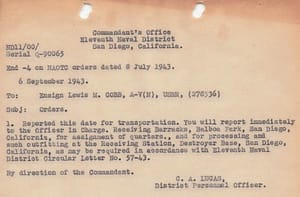
Building B7, Room 4, in Balboa Park became my temporary home away from home until I could arrange transportation to Pearl. Didn’t take long: I arrived in San Diego on 6 September and received orders to vacate the barracks and report to the Port Director at 0800, 12 September. By that afternoon I was on the USS Fletcher, DD-445, hitching a ride to Pearl.
As a Navy pilot I was nothing more than a passenger on the destroyer. For seven glorious days I had no responsibilities. I enjoyed being at sea. I spent most of my time eating, playing cards or Acey Deucey with other pilot-passengers, or just trying to stay out of the way of the ship’s sailors on duty. The only negative was that initially I didn’t know any of the other aviators—I was the only guy from my training squadron on the boat. I missed the good friends I’d made. But by the end of the trip I had a new bunch of friends.
We had a few days of heavy weather on the passage, but I’ve never been prone to sea-sickness, so I was able to enjoy the rolling motion of the ship. I made the most of my time off, figuring that when I reported to VF-5, life would speed up considerably. And, boy, did it!
**********
“Sit down, Ensign Cobb,” said LCDR Owen. “I’ve examined your record, and it looks like you might have the makings. We’ll see.”
I’d arrived several days earlier and survived the gauntlet of orientation, assignment of quarters, a medical exam, being outfitted with necessary gear, and other introductory matters. Now it was time for the interview with my immediate superior, the CO of Fighting Five. I was both excited and honored to be joining VF-5, which I considered to be the premier fighter squadron in the Pacific.
“This is your first actual combat deployment, Cobb. For some reason, the powers that be have honored you by assigning you to one of the best combat squadrons aboard one of the most storied fleet carriers in the Pacific, the Yorktown. I expect nothing but excellence from all my pilots every day, every patrol, every strike, every landing, every report. Is that clear?”
I swallowed hard. This was not the sort of warm fuzzy greeting I’d hoped for, but rather a blunt meeting with reality. “Yes, sir. I’ll do my best.”
“I don’t want your best. Maybe your best won’t cut it. I want consistent superior excellence in every aspect of flight operations.”
“Yes, sir.”
“Ensign, you are a replacement pilot. Are you aware of what that means?”
“I expect it means that you need more pilots to fill out the complement of the squadron, sir.”
“Technically that’s correct, but it means a whole lot more than that, Cobb. Your presence in this squadron means we have lost a brother warrior and a friend. It means that the pilot you are replacing was a man the rest of VF-5 knew well and trusted. To many in the squadron he was a good friend, perhaps a best friend. He was someone’s wingman, someone’s division or section leader. He was a pilot who had earned the respect and trust of those who flew in tight formation with him through multiple combat missions.
“But now he is someone who is dead or missing. Someone who is being grieved, in as much as we are able to do so in a combat theater. You cannot fill his shoes, Ensign. No one can.”
“Yes, sir,” I said, humbled. I didn’t know what to say. The difficulty of my role was becoming clear. I could fly alongside the rest of the squadron, but I could not replace the valued dead.
Commander Owen leaned back in his chair, and his face softened. “I need you to understand this, Cobb, for your own good. The squadron is not going to immediately accept you—but it has nothing to do with you personally. Every time they see you, every time they hear your call-sign, it reminds them of the man we lost. After they’ve had a few chances to fly a CAP or a strike with you, it will change. Eventually you too will become a comrade, a brother-in-arms, not a replacement. Do your job well, give it time, and by all means don’t be cocky. These men are experienced fighter pilots—you are not. Your best move is to shut up, listen up, and learn from them.”
Owen took an order book out of his desk, scribbled on the top sheet and handed the flimsy to me. “Here. I’ve authorized you for up to six hours of familiarization flying in the F6F-3 over the next few days. Take this to the flight line, show it to the officer in charge. He’ll give you an airplane and will instruct you about restricted areas. Pay attention and stay out of the restricted areas, or some trigger-happy jarhead on AA duty might be tempted to put holes in your Hellcat. It’s happened before.
“Welcome to Fighting Five, Ensign Cobb. Dismissed.”
**********
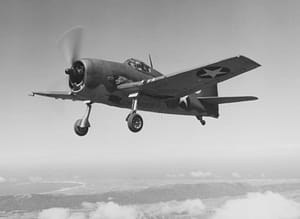
I walked around the airship, admiring its lines. It was stouter and bigger than the F4F with a much more powerful engine. The F4F Wildcat boasts a fourteen cylinder, radial Pratt & Whitney R-1830 Twin Wasp powerplant capable of producing 1200 horsepower. It is a very reliable engine, used in other aircraft such as the multi-engine B-24 Liberator and PBY Catalina. But the R-1830 can’t compare to the Hellcat powerplant. The people at Grumman equipped the F6F with the Pratt & Whitney R-2800 Double Wasp powerplant. It’s an eighteen cylinder beast in a radial arrangement producing 2000 horsepower. I couldn’t wait to see what it could do.
Clambering into the cockpit, I examined the Hellcat’s arrangement of instrument panels and various controls. The bad news is that they were quite a bit different from the Wildcat’s layout, and it would take a while before I could reach every switch, circuit breaker, and control in the dark without searching for it. The good news is that the Hellcat is a clearly superior fighter: faster, higher ceiling, better climb rate, better armor to protect the pilot, hydraulic controls for the landing gear (no more hand crank!), and built to take a lot more punishment than the Wildcat. Like the later versions of the Wildcat, the Hellcat sported six fifty-caliber machine guns, three on each wing. The engineers at Grumman had also spaced the main landing gear farther apart, reducing the problem of ground-looping. All in all the Hellcat was a big step up from the Wildcat.
“Okay, girl, let’s see what you can do.”
I ran through the engine start sequence and was rewarded with a throaty roar. My grin was so big I thought my lips would split. This baby has a whole lot more under the hood than the Wildcat. It’s like comparing a model T to a muscle car.
After receiving taxi and takeoff clearance from the tower, I jammed the throttle forward and released the brakes. In a matter of seconds I was racing down the runway and airborne almost before I was aware of it.
I was dying to put the aircraft through its paces: acrobatics, spins, stalls, maximum ceiling and such. But it was my first hop in a Hellcat and late in the day, so I contented myself with trimming for straight and level flight, doing coordinated turns, using the fuel mixture and throttle controls and trying the variable pitch prop. These exercises forced me to locate the basic flying controls and instruments, a necessary matter since the cockpit layout was somewhat different from the Wildcat. I also wanted to get a taste for how the heavier aircraft handled in various simple maneuvers—the empty weight of the Hellcat was nearly twice as heavy as the Wildcat. I shot five touch-and-goes to get the feel of landing the machine. When I finally taxied back to the flight line, I was ecstatic. The Wildcat was a great airplane, but the Hellcat was vastly superior in every respect. I could hardly wait for tomorrow, so I could take her up again!
The next day I flew twice, each hop an hour long. I took her up to 30,000 feet to test the climb rate of the aircraft. From that high-altitude vantage the Hawaiian Islands far below appeared as beautiful verdant jewels set in an azure sea. I had to force myself to remember I wasn’t sight-seeing.
Climbing to such altitudes also required me to become accustomed to the oxygen mask controls. Then I practiced spins and stalls until I was sure I could recover promptly and properly. I also tried a dead-stick landing to get the feel of the aircraft when it was basically a gliding brick.
The next day Commander Owen took off in his own Hellcat to fly with me and evaluate my formation flying and acrobatics. He also observed me doing FCLP (Field-Carrier Landing Practice), which basically involves landing on a runway painted to look like a carrier deck, complete with arresting wires and an LSO (Landing Signal Officer). The LSO (also known as ‘Paddles’) gives a landing aircraft the signal to ‘cut’ the engine if his attitude, altitude and speed are correct for a safe landing or a ‘wave-off’ if not.
Commander Owen was satisfied with what he saw in my flying, and on 27 September, 1943, he submitted my orders to join Fighting Five for approval.
**********
The barracks on Maui weren’t too bad, other than being overrun with cockroaches at night. I was sitting in the lounge area at one end, writing a letter to my dad. Suddenly I heard a familiar voice.
“Well, well, well. If it isn’t Lou Cobb! Fancy meeting you here!”
“Rocky Aldridge, great to see you! When did you arrive?”
“Yesterday. Just finished all the receiving station mumbo jumbo this morning. I had no idea I’d find you here.”
“VF-5?”
“Yep.”
“Why didn’t you sail with the rest of us?”
“You were on the Fletcher, right?”
“Right. Where were you?”
“Bureaucratic limbo, I reckon. After we all qualified at Great Lakes, my orders got misdirected. When they finally caught up with me and I arrived at Balboa Park, the Fletcher had sailed. I hitched a ride on the USS Cimarron, AO-22.”
“The Cimarron? Isn’t that a fleet tanker?”
“Yep. It wasn’t the Ritz, but hey, it floats, right?”
“Well, welcome. You’re a sight for sore eyes. I didn’t know anyone when I first got here, but I’ve made a few friends. There are some pretty swell guys in VF-5. Have you talked to Commander Owen yet? He’s the CO of VF-5.”
“I’m headed that way now. I wanted to drop my seabag here first—tired of toting it all over the base.”
“I’m sure he’ll have a warm and friendly welcome for you,” I said, smiling.
“Uh-huh. Something in your grin tells me he’s not exactly working for the Welcome Wagon.”
“Nope.”
When Alridge left, I sat down, chuckling, and returned to my letter writing.
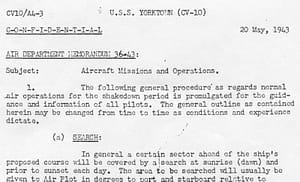
For the next two weeks most of the squadron stood down as it was on a scheduled R & R for the veterans. The replacement pilots (there were two others besides Rocky and me) continued our familiarization hops in the Hellcat. We also spent the time learning our way around the Yorktown (a challenge in and of itself) and digesting the various classified protocol and procedure bulletins directing carrier air operations. These directives were aimed at making the carrier air wing a safe, efficient and lethal strike force. They covered everything from radio communication protocol, patrol search patterns, navigating over open sea, using the “point option” method to find our way back to the carrier after a strike, locating rescue destroyers and submarines tasked to recover aviators who had to ditch or bail out, and much more.
The break ended abruptly on 13 October for the whole squadron. In the space of two days I spent six hours in the cockpit, much of it practicing field carrier landings. On one high-altitude hop I noticed that the Yorktown had put out to sea—her slip was empty. The buzz going around the squadron was that we were preparing for a strike. We didn’t know when or where, but the increased tempo of training and operations made the rumor very credible.
**********
Ten days later the Yorktown left her mooring again. The next day, 15 October, 1943, the entire air group launched from the Naval Air Station on Maui and flew a hundred miles off the coast to land on the carrier. We were scheduled for several days of training. Because it was a training exercise that included four replacement pilots on our very first deployment, the ship was not employing the usual tightly choreographed landing sequence. Normally during a recovery evolution, the aircraft being recovered would be stacked up in the pattern, landing one after the other, the previous plane being cleared forward of the barrier even while the next plane was on final approach. But not today. Everyone felt a tad rusty, so the air group was being recovered a little more slowly. We all guessed that CAG (the Carrier Air Group commander) would restore the normal operational tempo once he felt we’d gotten the rust knocked off, probably tomorrow or the next day.
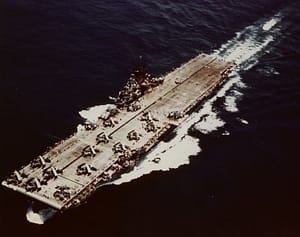
By a quirk of fate (or so I thought), I was the very last man in the landing pattern, the tail-end-Charlie. The Yorktown was headed into the breeze; the wind across the bow was forty knots—perfect for landing. When a Hellcat hit the deck, its forward speed relative to the carrier would be only about twenty knots. Not counting my CarQual landings at Great Lakes, this will be my first real landing on a carrier. Inside my flight suit I feel sweat from my armpits trickling down my side. My palms are damp. I tell myself, I can do this, but I’m not quite sure I believe me. Oh, Lord, the ocean is so big and that carrier is so small!
It’s one thing to land on the Sable steaming along on Lake Michigan. It’s another matter entirely to land on a carrier on the open sea in the Pacific out of sight of land. Great rollers of waves were coming like slow clock-work, lifting the stern of the ship fifteen feet up then fifteen feet down as they passed under the keel.
“BAKER 3-4, this is HOME-PLATE, you are clear to land.” I recognized the voice of Commander Owen. He’d landed his fighter first, and had run up to Pri-Fly to handle the radio duties as he observed the rest of our squadron land. As I mentioned, I was the last one to land.
“BAKER 3-4 is clear to land, roger that HOME-PLATE.”
As I entered the downwind leg, I verified that the tail hook was locked in the down position, check. Landing gear—down and locked, check. Tail wheel locked, check. Flaps down, check. Cowling flaps open, check.
I banked left and came around for the final approach. I was too high, I could see that immediately; so could the LSO, and he positioned his paddles telling me I was too high. I think I had been so concerned about verifying my landing preparations on the downwind leg that I didn’t pay attention to my altitude.
I was coming up on the carrier so fast that I over-corrected, pushing the nose down too steeply. I’d made a mess of my approach and there was no fixing it. The LSO waved me off so I brought the nose back up and banked left to reenter the landing pattern.
This time I paid close attention to my speed and altitude. Once I banked left into final approach, the LSO signaled ‘Roger,’ indicating I was in the groove. I was right on the money. But then, perhaps a hundred feet from the carrier, the stern lifted up as a great roller passed under the keel. It unnerved me—I felt like I was going to crash into the fantail, even though Paddles maintained his ‘Roger’ signal. Yanking the yoke back and pushing the throttle forward, I sailed over the deck without touching, then banked left again. Another landing opportunity missed. Now I was rattled. I should have trusted the LSO—I could have landed. I screwed up and I knew it. I could see the guys from the squadron on the starboard side catwalk, watching my dismal performance.
On the next pass I completely lost my nerve. It was a good approach, but when the cut signal came from the LSO, I couldn’t do it. I felt like I was too high. As I banked left to reenter the downwind leg, the radio crackled.
“BAKER 3-4, this is HOME-PLATE. Are you experiencing a malfunction?” As Commander Owen keyed his mic, it picked up Captain Jocko Clark grousing in the background, “If he misses this next approach we’ll have to shoot him down.”
“HOME-PLATE, BAKER 3-4, negative, no malfunction. I was too high.”
“Negative, negative, BAKER 3-4, your approach was fine. Fix your eyes on Paddles, he’ll bring you in safely.”
“BAKER 3-4, Roger Wilco.”
I extended my downwind segment a bit, trying to settle down. I knew that this next pass would probably determine whether I could remain a carrier pilot. That realization settled my nerves into a steely determination. I decided I would trust the LSO, no matter what.
I banked left and entered the final approach for the fourth time. My extended downwind leg meant I was a little low when I entered the final approach, so the LSO prompted me to pull up the nose slightly. A second later he gave the ‘Roger’ signal. Once again, I was in the groove. Like locking on a target, I fixed my eyes on Paddles and committed myself to follow his guidance, come what may. As I neared the carrier, he coached me through a few minor corrections, then extended both paddles: ‘Roger.’ Then ‘Cut’. I chopped the throttle and relaxed the right rudder pressure, pulling the nose up for a three-point landing. The tail hook snagged, and I was finally on the deck safely.
My legs were a little rubbery when I climbed out of the airplane. Commander Owen was standing on the flight deck, waiting for me. He didn’t look happy. “The captain is in Pri-Fly, Ensign Cobb, and he wants to see you immediately!”
“Yes, sir.” I steeled myself, knowing that I was going to face the music and it wouldn’t be pretty. Captain Jocko Clark had been in the Navy since 1917. Over the years his postings had included stints on cruisers and destroyers, and teaching at the Naval Academy. Clark had trained as a naval aviator at NAS Pensacola, earning his wings in 1925, after which he served as the Air Officer on several different ships, finally finding himself in command of the USS Yorktown (CV-10). He was a decorated and competent officer, and the word around the squadron barracks was that we were glad to be serving on his ship. Unfortunately I hadn’t make a very good impression on him just now.
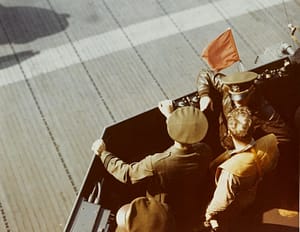
I entered Pri-Fly, and all eyes turned to me. The tension in the room was palpable. There were a few coughs as several men turned away, trying to hide the disgusted smirks on their faces.
“Captain, sir. You wanted to see me, sir,” I said, standing ramrod straight and saluting.
Clark turned and fixed me with a steely glare. For a minute he said nothing. Finally, his voice slightly raised, he demanded, “Ensign Cobb, I certainly don’t need you, but I do need that airplane. If I EVER let you launch from this carrier again, can you guarantee me that you will land that airplane?”
As a twenty-year-old, freshly-minted naval aviator facing the wrath of a highly-decorated captain who’d been serving in the navy since before I was even born, it was mighty intimidating. But in that instant I decided that if I can face the possibility of splatting against the fantail of this carrier, then I can face the wrath of this angry captain.
“Yes, sir, I can guarantee you that,” I replied with conviction.
He glared at me briefly, then nodded. “Dismissed.” As he turned away, I saw him wink at Commander Flatley.
**********
That evening I stood on the starboard side catwalk just forward of the island, enjoying the warm sea breeze and a beautiful sunset.
“Join you?”
I turned and saw Rocky Aldridge. “Sure, Rocky.”
He stood next to me, hands on the rail, looking out to sea. There was a destroyer, one of our escorts, steaming four hundred yards off the starboard quarter. In the gloaming I could see several sailors on the can’s port side railing staring back at us.
“What happened to you today, Lou? Of all people, I didn’t expect you to have that much difficulty.”
I sighed. I’d been trying to figure it out myself. It was very humiliating, especially when Captain Clark called me out publicly. “I’m not real sure myself, Rocky. I think that first wave-off must have rattled me, because for the next two approaches I was frankly terrified. With every failed attempt to land, I felt more fear. I screwed up—bad.”
He was silent for a moment. By now it was dark enough that the phosphorescence in the water was glowing as the wake from the carrier disturbed it.
“Think they’ll ever let you take off again?” Rocky asked.
“Don’t know. Hope so. I think I’ll be fine next time.”
“What’s going to be different, Lou? Conditions today were better than we’ll ever see in combat. Why do you think it will be different next time?”
I turned to him. “Because of what I decided on my last approach. I decided that I’d rather die then wash out as a fighter pilot. So I did what I had not been doing on the first three attempts: I put my life in the hands of the LSO. Whatever he directed me to do, I was going to do—no matter whether I thought the fantail was rising or dropping. If I die, I die.”
I turned and looked across the water. The destroyer was blacked out and was barely visible. I chuckled and looked back at Rocky. “If I go splat against the fantail, at least it will be his fault, not mine.”
**********
“Sit down, men,” Commander Owen directed. The whole fighter squadron had gathered in the ready room, as we’d been told an announcement was forthcoming.
“The squadron is flying back to Maui today. For the next three weeks we’re going to hit training hard, real hard. Vacation time is over, men—as of right now we start operating at a much higher tempo. CAG—that is, Commander Flatley—is not at all happy with what he’s seen on this cruise. Last night Commanders Flatley and Crommelin got their asses handed to them down in Flag Country. You men know how the chain of command works: the admiral chews out the captain, who then chews out CAG, who then reads the riot act to the CO of the squadron. Then the CO talks to me. Let’s just say his language this morning was more colorful than mine is. Now it’s my turn; I have to rake you men over the coals. So here we go.
“Fighting Five, particularly VF-5, looked sloppy on this cruise. And it wasn’t just you pilots, but the plane captains and deck handlers, too. The whole support crew looked rusty.
“Well, I know why we looked sloppy, but my boss was not inclined to hear any excuses from me. Anyway, here’s the problem: all of us, pilots, support crew, armorers, we all have a brand new airplane—the F6F—and we received them barely a month ago when most of us were on leave. We’ve not had the opportunity to run through our different operational evolutions until this cruise—and it didn’t go well. It was pretty ugly.
“So we’re going back to work, and we’re going to stay at it until all the bugs are ironed out. Over the next three weeks you men are going to be flying a great deal, practicing virtually every skill: acrobatics, navigation, gunnery, bombing, strafing, formation flying, the whole nine yards. We’ll also be refreshing you in some of John Thach’s new tactics, including using smaller sections and divisions. We’re going to emphasize the beam defense position—the Thach weave. Everyone is included, no one is exempt: veterans and replacement pilots alike. The next time we put to sea, things had better work like the finely tuned squadron I know we can be. Any questions?”
Lieutenant Bozard spoke up. “Sir, some of us have been at this long enough to recognize the pattern. When we’re back at one of our anchorages doing a little R & R, things slow down. Then we get chewed out. And then we start intensive training evolutions. And then we go into combat.
“Sir, are we preparing for a strike somewhere?”
A hint of a smile flickered briefly on Commander Owen’s face before he caught himself and resumed his stern expression. “You know I can’t tell you that, Boz. If we were getting the squadron ready for a strike, that would be classified information. But I’ll say this—you veterans can draw your own conclusions.”
**********
Over the next twenty-four days I put in just over thirty-two hours in the cockpit. Commander Crommelin kept the entire squadron busy. By the end of that period we all knew the Hellcat as if the cockpit had been our cradle from birth. The purple jerseys, the ‘grapes,’ were refueling our aircraft quickly. The red jerseys, the armorers, could load our machine guns in record time without mistakes, or attach bombs or external fuel tanks to our hardpoints rapidly without missing a lick. The aircraft mechanics became so familiar with the F6F that they could diagnose and fix problems swiftly, whether it was replacing a weak strut in the landing gear or swapping out an entire Pratt & Whitney Double Wasp powerplant. The readiness and confidence of the squadron and its support personnel grew once again—we are the Fighting Five and we are ready to let the Japanese know it!
**********
Well before dawn on 11 November, 1943, the Yorktown cast off her moorings. That afternoon the Fighting Five flew from Maui to the carrier, by now well out to sea. Once again I found myself to be the tail-end Charlie in the landing sequence. As I turned upwind for the final approach, I reminded myself to trust the LSO and follow his every instruction.
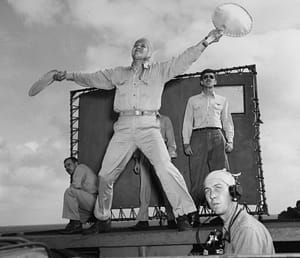
The signal was ‘high’, so I backed off the throttle slightly, and soon he placed the paddles in the ‘roger’ position. A few more corrections and before I knew it he was signaling ‘cut.’ A brief second later I hit the deck hard, snagged the number two wire, and came to a quick stop. I will confess that several drops of sweat drooled down my neck. Commander Owen was standing by the island and gave me a thumbs up.
But instead of clearing me beyond the barrier, the deck crew dropped the barrier. Crackling in my headphones was an instruction to launch and come back for a second landing. I maneuvered into position for take-off, and the deck crew connected my Hellcat to the catapult. After setting all the flight controls for take-off, I saluted the Catapult Officer and in seconds was airborne again.
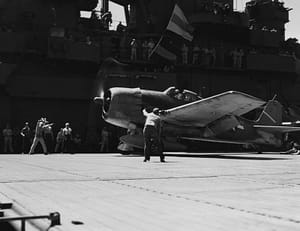
On my next landing I snagged the third wire, and the same thing happened again. The barrier was lowered, I was attached to the catapult and launched again. I had a feeling that Captain Clark was watching the whole time. In the end, I made four perfect carrier landings before the deck crew directed me to a tie-down spot on the deck.
“Captain Clark wants to see you. He’s in Pri-Fly,” Commander Crommelin said to me as I jumped from the wing to the deck.
“Yes, sir.”
I removed my flight helmet and climbed the ladder up to Pri-Fly. “Sir, you wanted to see me?”
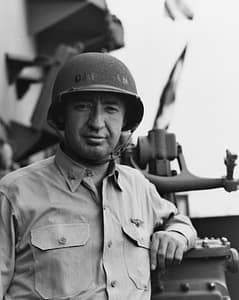
Jocko Clark’s back was turned to me as he studied the deck below. The deck crew was arming and spotting four Hellcats for the evening Combat Air Patrol. Finally he turned around, and I saluted. Returning the salute, he growled, “Ensign Cobb, you’ll do. Dismissed.”