


by: Katie DeLand
In Ohio, a diagnosis of kidney failure doesn’t just change a person’s health. It can flip their financial stability upside down. For many patients, dialysis becomes an immediate and permanent part of life, requiring hours of treatment multiple times a week just to survive. But beyond the physical and emotional toll, too many Ohioans face another burden they never expected: overwhelming medical costs that threaten their financial future.
A recent story highlighted an Ohio veteran fighting not only for his life, but for a kidney donor. His story is powerful, but it also shows the broader reality that patients across our state deal with. While individuals battle kidney disease, they are often navigating a confusing insurance system at the same time, leaving dangerous gaps in coverage.
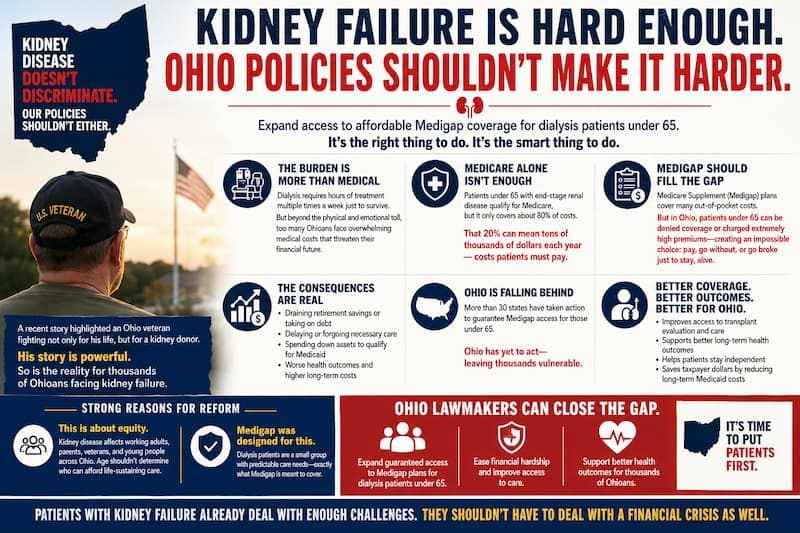
By law, end-stage renal disease patients qualify for Medicare, even if they are under 65. However, Medicare alone was never intended to cover the full cost of long-term, high-intensity care. Patients are responsible for the remaining 20% of treatment costs that Medicare doesn’t cover, a percentage that can quickly translate into tens of thousands of dollars annually.
This is where Medicare Supplement plans, also known as Medigap, are meant to help. Medigap plans are secondary insurance plans that cover many of the out-of-pocket costs that traditional Medicare doesn’t, providing critical financial protection. But in Ohio, access to affordable Medigap plans is not guaranteed for patients under 65. Unlike Medicare beneficiaries over 65, younger patients with kidney failure in Ohio can be denied Medigap coverage or charged extremely high premiums. For individuals already dealing with a life-altering diagnosis, this creates an impossible choice – pay insanely high costs, go without coverage, and drain savings just to stay alive.
The consequences are real. Some patients are forced to drain retirement funds or take on significant debt. Others must delay or forgo necessary care due to cost concerns. Many spend all their assets just to qualify for Medicaid, shifting financial responsibility to the state rather than preventing hardship in the first place.
Ohio is not alone in facing this issue, but it is falling behind. More than 30 states have taken action to guarantee access to Medigap plans for those under 65, recognizing that age should not determine whether someone can afford life-sustaining care. Ohio has yet to adopt similar protections, leaving thousands vulnerable.
From a clinical perspective, this gap in coverage can also affect long-term outcomes. Access to comprehensive secondary insurance and care plays a vital role in determining whether patients can get on the kidney transplant list. Patients without adequate coverage may face additional barriers to evaluation and post-transplant care, causing many to stay on dialysis longer and create worse health outcomes and higher health care costs
There is also a strong economic argument for reform. When patients are forced into Medicaid, the state absorbs higher long-term expenses. Expanding access to Medigap coverage would help more Ohioans maintain financial independence while saving taxpayer dollars.
Some may argue that broader Medigap access could disrupt the insurance market, but dialysis patients represent a relatively small group with predictable care needs. These are exactly the circumstances Medigap was designed to help. At its core, this issue is about equity. Kidney disease doesn’t discriminate by age. It affects working adults, parents, veterans, and young people across Ohio. Our policies should reflect that reality, ensuring that no one is penalized simply because their illness occurred before they turned 65.
Ohio lawmakers have an opportunity to close this gap and align the state with others that have already taken action. Expanding guaranteed access to Medigap plans for dialysis patients under 65 would ease financial hardship, improve access to care, and support better health outcomes.
Patients with kidney failure already deal with enough challenges. They shouldn’t have to deal with a financial crisis as well.