


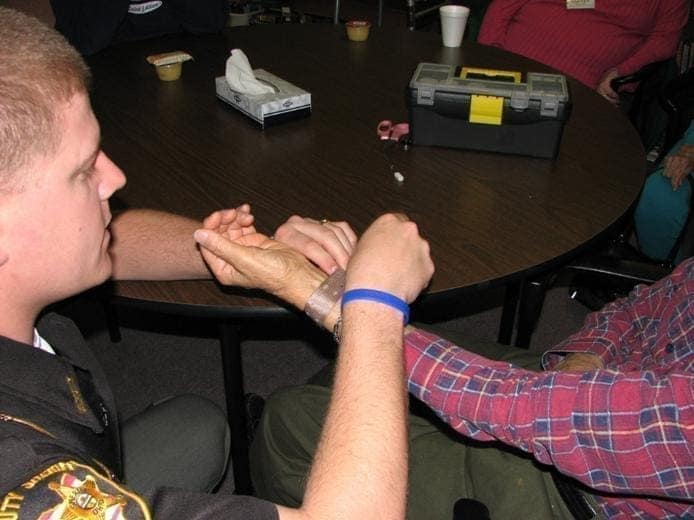
TROY—The Miami County Sheriff’s Office offers its citizens an invaluable peace of mind with Project Lifesaver.
Project Lifesaver is a community based, public safety, non-profit organization that provides law enforcement, fire/rescue, and caregivers with a program designed to protect, and when necessary, quickly locate individuals with cognitive disorders who are prone to the life threatening behavior of wandering.
The program was founded in 1999 in Chesapeake, Virginia, when Gene Saunders, who worked in search-and-rescue, noticed there was issue with people who have Alzheimer’s or dementia wandering from home and getting lost.
“He basically took a principle from hunting,” Michael Marion, Miami County Sheriff’s Deputy said. “The transmitters used were put on dogs when they would go into the woods. The hunters would use it to find their dogs.”
The Miami County Sheriff’s office has offered the program since 2004, at no charge to citizens.
“We want to make sure we provide this service to the community as no cost to them,” Marion said. “Not everyone can afford all of it. We, the Sheriff’s Office pays for mostly everything. With either a grant, or donations.”
The necessity of the program was determined through the correlation between cognitive conditions and the act of wandering.
With the increase of cognitive conditions since the creation of the project, the program has grown from a localized program to a program recognized internationally as a proven and effective method of bringing loved ones home.
Marian added that the Sheriff’s Office is proud to be able to offer the community Project Lifesaver.
The Sheriff’s Office serves about 20 to 30 people with the program currently.
Some examples of those they serve include citizens suffering from Alzheimer’s, dementia, or those who have physical or developmental disabilities.
Not only are members of the Project Lifesaver team trained in the use of the electronic tracking equipment, but also in the methods used to communicate with a person who has Alzheimer’s or another related disorder.
For more information on the program, contact Lieutenant Randy Slusher at 937-440-6085 ext. 7146.