


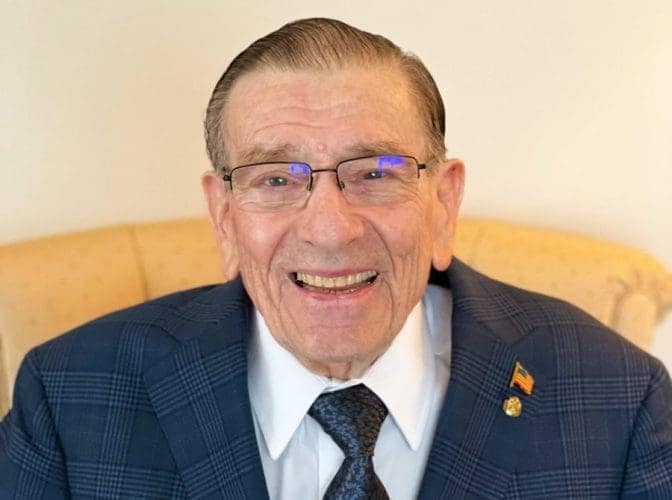
GREENVILLE – The Honorable Jim Buchy served as the guest speaker at the Republican Men’s Breakfast held Saturday before Christmas 2025. During his remarks, Buchy reflected on two pivotal battles from the Revolutionary era that helped preserve the fragile beginnings of what would become the United States of America. He concluded his presentation by offering thoughtful commentary on the nation’s current state, emphasizing the responsibilities required to preserve freedom and maintain America’s role as a free nation and world leader.
“In eleven days, we’re going to begin celebrating 250 years of this country’s freedom,” Buchy began. “Before we do, I want to reflect and go back to the first two battles that were fought—and won—in the Revolutionary War. Because if we hadn’t won those battles, we wouldn’t be sitting here today.
“It goes back to 1775, when Washington was put in charge of the Army. He took Boston away from the British, and he had to do it—because the troops fighting back then were basically a militia made up of volunteers. They weren’t paid, or if they were, it was very little, because there was no money. Whatever money did come came from private individuals who paid for the war, and most of them ended up bankrupt.
“Washington and the army were suffering. Morale was low. They didn’t have enough equipment. They didn’t have enough food. In fact, they were running out of food. The British were holding on—and winning.
“To understand how Washington turned this around, you have to go back earlier, to 1758, during the French and Indian War. The French held Fort Ticonderoga in northern New York. They had about 3,500 troops there and successfully fought off 16,000 enemy soldiers. They held the fort.
“After that war ended, there really wasn’t much need for the fort anymore. Eventually, only a skeleton force remained—around 40 soldiers. But what Fort Ticonderoga still had was cannons, gunpowder, and rifles. They had everything Washington needed to take Boston.
“Ticonderoga was about 300 miles from Boston. Washington knew that if he had any chance to win—and to turn morale around—he had to take Boston and drive the British out. So he enlisted the support of Henry Knox and sent him to Ticonderoga to bring all that military hardware back to Boston.
“Knox told Washington he could do it in 17 days.
“The weather turned bad, and it ended up taking 40 days.
“The inventory he brought back included 59 cannons, weighing a combined 120,000 pounds, hauled on 42 sleds with 80 yoke of oxen. They had to cross the Hudson River four times to get all that equipment from Ticonderoga to Boston.
“But they did it.
“Before that, a group of 82 farmers and businessmen had gone to Ticonderoga and launched a surprise attack around 3:30 in the morning. The British had one sentry on duty and about 42 soldiers total. They woke the sentry—he surrendered. They woke the rest—and they surrendered. Fort Ticonderoga was captured without firing a single shot.
“That’s how they gained control of the fort and everything in it.
“All that artillery was eventually transferred to Washington in Boston. Boston was surrounded by hills, and Washington placed the cannons on those heights. The British couldn’t fire up at them. When the British realized those cannons were positioned to fire down on them, they gave up. Eleven thousand British troops evacuated Boston, and Washington had his victory.
“That victory turned morale around for the entire army, and Washington began moving south toward New York.
“The British had a stronghold in New York City and throughout New York State. As Washington moved south, he began suffering defeats, and the army found itself right back where it had been before—low morale, enlistments running out, and desertions increasing.
“Washington had to figure out a way to beat the British again.
“He crossed into Pennsylvania and came up with a secret plan. The British were entrenched in New York, but their allies—the Hessian mercenaries, Germans fighting for the British—were stationed in Trenton, New Jersey.
“Washington planned a surprise attack for Christmas, knowing no one would expect it. The Hessians weren’t expecting a fight. It was Christmas Eve. They were celebrating, partying late into the night, and eventually went to bed believing nothing was going to happen.
“Washington planned to have three divisions cross the Delaware River at different points and converge on Trenton. The weather was terrible. The river was freezing, filled with ice chunks. Many of Washington’s men had ragged uniforms, and some didn’t even have shoes. They crossed the Delaware barefoot, in freezing conditions.
“But they crossed.
“In the early morning hours, they launched the surprise attack. The Hessians were completely caught off guard. Washington lost only a handful of men. The Hessians lost around 950, and their commanding general was mortally wounded. As he lay dying, Washington was with him, and the general told him, “I surrender. Please take care of my troops.”
“That victory—along with the victory in Boston—were the first two American victories of the war, and they completely turned around the morale of the army.
“Washington knew that by January 1, many enlistments would expire, and he would be left without an army. That’s why he planned the Christmas attack. He rolled the dice—and he won.
“If it weren’t for those two victories, we might not be here today.
“That’s how important they were to the success of the United States.
“As we celebrate the 250th anniversary of the signing of the Declaration of Independence, the fact is, the United States of America is the longest-running free republic in the history of civilization. We often take that for granted. We hear it all the time, or at least occasionally, but it is true: freedom is not free, and it is not guaranteed.
“If we are to keep our freedom, we have to fight to keep it. What is going on now is simply this — the men who gave their all so that we might be here today as free people require something of us in return. We have to take the resolve to carry on what has now become two wars that we face in this country.
“It is a war of two religions.
“On one side is the religion of government — where government controls the people, where people must worship government in order to subsist. We also call that Communism or Totalitarianism.
“On the other side is the war of Christ. Christ equates to freedom.
“This is a Judeo-Christian nation. Fifty-two of the signers of the Declaration of Independence were Christians, and four others believed in some form of deity. That was the character of the men who gave us the United States of America.
“We are a Christian nation, and if we are to stay a free nation, we have to be more Christian.
“That makes two wars. The question is: who is going to win?
“We are!
“That is the resolve we must take from this room — that when we leave here, we continue to educate and teach our families, our friends, and everyone we know. As we approach the 250th anniversary, it should serve as a foundation — something we must work hard to preserve — to keep what was given to us by those soldiers back on Christmas Day of 1775.
“It’s really simple. There is nothing exotic about this. But it will take work, and it will take resolve. We have to stand up and continue to fight for what is right — and that is keeping freedom.
“So my message today is very simple:
“Merry Christmas.”