


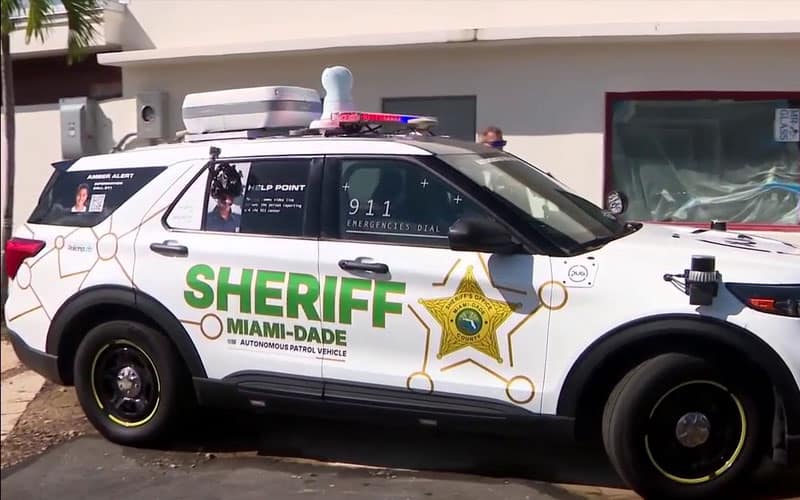
In what law enforcement officials are calling a milestone in policing innovation, the Miami-Dade Sheriff’s Office (MDSO), in partnership with Policing Lab, has unveiled the nation’s first fully autonomous police cruiser equipped with drone deployment capabilities.
The new vehicle, known by its acronym PUG — short for Police Unmanned Ground — is part of a pilot program intended to test how autonomous systems can support deputies, improve response, and strengthen public safety.
High-Tech Features & Capabilities
The PUG is outfitted with a robust suite of sensors and systems, including:
-
360-degree cameras and audio sensors
-
License plate recognition
-
Thermal imaging
-
AI-driven analytics and integration with crime databases
-
A drone deployment module that can send up an unmanned aerial vehicle to gather real-time overhead views for incident response
Officials say the drone function is especially valuable in situations such as active shooter responses, search in difficult terrain (e.g. dense foliage or rooftops), or restricted zones where sending a human-operated vehicle might be slow or risky.
The vehicle was donated by Policing Lab, a nonprofit organization focused on integrating evidence-backed technology into law enforcement. Its autonomous driving system is reportedly based on tech from Perrone Robotics.
Pilot Phase & Community Engagement
The program is initially launching as a 12-month pilot. During this period, a deputy will ride inside the PUG as a safety measure and to collect community feedback before the vehicle transitions to fully autonomous operations.
Sheriff Rosie Cordero-Stutz emphasized that the vehicle is meant to augment, not replace, human officers:
As part of community outreach, the PUG will appear at public events throughout Miami-Dade over the coming weeks so residents can see it firsthand and share concerns or suggestions.
Officials have stressed that the pilot is being launched without additional cost to taxpayers, thanks to the private donation.
Potential Benefits & Challenges Ahead
Proponents see numerous possible advantages:
-
Force multiplier: Allowing deputies to monitor more territory remotely
-
Faster situational awareness: Via drone feed and sensor data
-
Enhanced officer safety: Sending the vehicle ahead in potentially hazardous zones
-
Data and analytics: Automating routine patrols and event flagging
Yet, the program also faces hurdles:
-
Privacy concerns: Some community members may worry about surveillance overreach
-
Technical reliability: Autonomous systems must perform safely in varied traffic and weather conditions
-
Regulatory and liability issues: Navigating rules for autonomous vehicles and drones in urban areas
-
Public trust: Transparency will be key to gaining community acceptance
Civil liberties groups have flagged similar programs elsewhere, calling for strict policies on data retention, accountability, and oversight. The pilot phase provides an opportunity to address such concerns in practice.
What Happens Next?
Over the upcoming months:
-
The PUG will run on preprogrammed patrol routes under human supervision.
-
Community feedback will be collected at public showings and via digital input.
-
Data will be analyzed for response times, incident prevention, and resource efficiency.
-
Based on results, the MDSO may expand deployment or adjust technology and policy.
If successful, the PUG could serve as a model for other U.S. jurisdictions exploring robotics, autonomous systems, and drone integration in policing. For now, Miami-Dade is charting new territory in how law enforcement institutions marry technology and public service.