


“Pilots, man your aircraft!” the speaker blared.
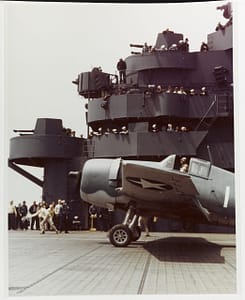
I quickly followed the other three pilots out of the ready room, dodging deck crew and spotted planes as I trotted to my Hellcat. The sun was high in a cloudless sky, and the deep blue sea stretched into infinity in every direction, dotted with numerous ships of the task force. Widely spaced rollers passed under the ship, gently see-sawing the bow and stern. A moderate sea breeze over the bow carried the salty aroma of the sea, mixed with the smell of oil, avgas, and aircraft engine exhaust.
As I approached my aircraft, the plane captain stepped up, a knowing smile on his face as he patted me on the shoulder. “Go get ‘em, sir,” he said, raising his voice to be heard above the clatter of the busy flight deck. He evidently knew this was my first combat launch.
“This is my sweetheart, sir,” he said, motioning to the F6F beside us. “I take really good care of her. She’ll treat you right if you treat her right. Try to bring her back without too many holes in her, okay?”
I grinned back at him. “I’ll do my best, Chief.”
I was now a carrier-qualified fighter pilot, and as far as I was concerned I was ready to rumble. Little did I think about the fact that I was just twenty-years old, inexperienced, and like most pilots my age, probably way overconfident. But I think overconfidence must be a job requirement for fighter pilots. In any case this was my first actual combat launch at sea—I’d be lying if I said I wasn’t nervous. You can bet that my hands were sweaty and my heart was pounding as I clambered into the cockpit.
**********
Today is 17 November, 1943, and the Yorktown (CV-10, aka. The Fighting Lady) is headed into harm’s way as part of OPERATION GALVANIC, an amphibious assault on the Gilbert and Marshall Islands. Task Force 50 sortied from Pearl on 10 November, Admiral Pownall commanding. The Yorktown, under Captain Jocko Clark, was part of Task Group 50.1 (TG 50.1). We were sailing in company with the Lexington (CV-16, aka. The Blue Ghost) and the light carrier Cowpens (CVL-25, aka. The Mighty Moo). The mission of TG 50.1 was to provide air cover for the amphibious assault, and to intercept any Japanese aircraft that might fly from the Marshalls to defend Makin or Tarawa during the landings. Capturing the Marshalls and the Gilberts was crucial to our eventual island-hopping campaign that would lead us to Japan.
**********
I settled into the cockpit and began working my way through the standard pre-launch checklist. The previous guy to fly this plane must have been a good deal shorter than my six feet, so I had to adjust the seat height and distance to the rudder pedals so my elbows would not collide with my knees. Along with all the other checks and settings I verified that my machine guns were safed and my armament switches were off. I was carrying a full load of ammo, plus a belly drop tank, plus four Mk. 54 aerial depth charges. It would really ruin everyone’s day if there were an accident with those babies.
I nodded to the plane captain, who was standing on the deck to my right front. He made a circling motion with his upraised right hand, signaling me to start the engine. After setting the mixture, propeller control, throttle, and other controls, I turned the ignition switch to “BOTH” and pressed the starter. The Pratt and Whitney R-2800 coughed, coughed again, and then caught. I idled her at about 900 rpm, waiting for the oil pressure to steady in its acceptable range. When the engine was running smoothly, I nodded at the plane captain. A brief minute later the deck crew removed the chocks and pushed me into the line up, unfolding and locking my wings into place.
Here we go I thought to myself. I gave the plane captain a thumbs up. He saluted, and the launch officer pointed his baton to the bow. I gave ‘er the gas and soon was airborne, following the three aircraft that launched before me. We rendezvoused at 3000 feet and proceeded to our CAP patrol zone, thirty miles ahead of the carrier. Once there we split into two sections, Lieutenant Gill and Ensign McClelland taking the patrol zone to the left of the task force’s course, and Lieutenant Bozard and myself to the right.
**********
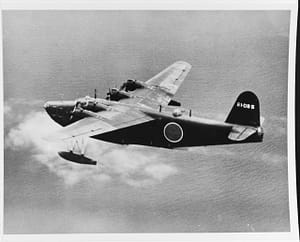
Unless there were Jap flattops in the area that we didn’t know about, the Task Group was not yet within range of any Japanese fighter. We were, however, within range of the big Kawanishi H8K—better known as the “Type 99,” or the Emily. This was the wide-ranging, four-engine flying boat used by the Japs for long-range reconnaissance. In the cat-and-mouse game played by both navies on the vast expanse of the Pacific Ocean, the trick was for the carriers to remain undetected as long as possible, both for our safety from Jap attacks and to give us the benefit of surprise when we attacked them. Every Japanese reconnaissance aircraft was a target priority of our combat air patrols—we didn’t want them to locate our carriers. The Emily was the enemy number one, you might say. In many respects, there was no patch of the Pacific out of range of that snooper, because it could be refueled on the water by submarines.
If we weren’t yet worried about Japanese fighters (because the Task Group was out of their range at the moment), we were concerned about submarines. It was a Jap sub that put paid to the old Yorktown, CV-5, as she was being towed back to Pearl for repairs after taking damage at Midway. Everyone aboard my ship was aware of that bit of history, and we all were determined that there would be no repetition of it. We wanted to honor the old Fighting Lady by carrying on her mission, not by joining her on the ocean floor.
I was flying in tight formation with Lieutenant Bozard as we both studied the air above and the ocean below. Carrying a full load of .50 cal ammunition for my guns, plus depth charges attached to the Hellcat’s hardpoints, we were equipped to handle anything we spotted.
Years of dove and duck hunting with my dad had left me with really good eyesight, and now it paid off. Thirty minutes into our patrol I spotted the tell-tale feather of a submarine periscope, probably snorkeling to recharge his batteries.
“CAIRO SCARLET 3-2, this is SCARLET 3-4, submarine contact at four o’clock, distance two miles, snorkeling.”
“Copy that SCARLET 3-4. Good eyes, Lou. … CAIRO-BASE, this is SCARLET 3-2, submarine contact one-one-oh degrees from my position, distance two miles, course three-three-oh. Shadowing. Please advise of possible friendlies.”
Since the unknown submarine was headed away from the Task Group, rather than attacking immediately Bozard was checking with the carrier first to see if there was any knowledge of our own boats in the area.
“CAIRO SCARLET 3-4, this is SCARLET 3-2, follow me.”
Bozard banked hard right and sharply descended to five hundred feet. We made one pass over the submarine. It immediately retracted the snorkel and dove. We came around for a second pass. Just as I was arming my depth charges my headphones crackled.
“SCARLET 3-2, this is CAIRO-BASE. Do not engage, repeat, do not engage. Contact is a verified friendly, a lifeguard. Resume patrol.”
“CAIRO-BASE, this is SCARLET 3-2, disengaging, resuming patrol.”
As I safed my ordnance and followed Lieutenant Bozard back up to our patrol altitude, I must admit the contact left a shot of adrenaline buzzing through my blood.
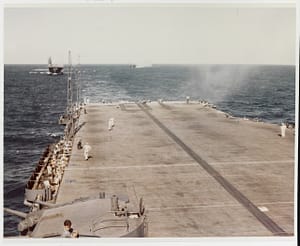
The remainder of the CAP was uneventful. Three and a half hours later the LSO gave me the cut and my tailhook snagged the second wire in a picture-perfect landing. I was glad to have broken the ice with my first CAP in an actual combat zone.
**********
On 19 November, the Fighting Lady introduced herself to the unlucky Japanese troops of Jaluit Atoll, dropping our dance card consisting of several tons of TNT and expending lots of .50 caliber ammo. If they hadn’t detected us earlier, they sure know we’re in the neighborhood now. Later that day the Yorktown launched five strikes on Mille Island, four combat air patrols, and two anti-submarine patrols. I was not yet involved in any strikes as I was still considered too green about the gills. That, however, would be changing very soon. Between 17 and 22 November I got to fly five CAPs.
*********
Rocky ran into the ready room where several of us were playing cards. “Crom’s been hit. He’s coming in now, and he’s injured pretty bad.”
We jumped up and raced after Rocky to “Vulture’s Row,” a covered balcony of sorts at the O-4 level of the carrier’s island, where pilots and crew not on duty could safely watch flight operations from well above the flight deck.
“Crash Crew stand by, Crash Crew stand by,” blared the loudspeaker. We could see them in their asbestos suits gathering at the base of the island, some carrying fire extinguishers, some breaking out the fire suppression hoses that could douse the whole plane in foam in a matter of mere seconds.
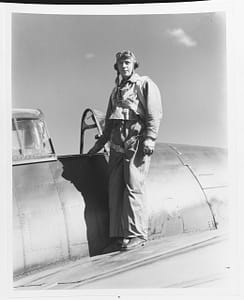
As Charlie Crommelin, the VF-5 Air Group Commander, flew past on his downwind leg we could see the damage, even at a distance. The canopy was completely shattered—no way he could see through it. Ensign Tyler, his wingman, was flying along side of him, coaching him and shepherding him back to the ship.
“My word,” Rocky muttered, “how is he even still alive? If that’s the damage on the outside, what must the cockpit be like?”
Lieutenant Bozard was standing with us. He shook his head. “Apparently his radio works. I heard the Flight Director say that he’s covered in blood and virtually blinded—can only see a tiny bit out of one eye. Landing with a shattered windscreen is bad enough. Landing on a carrier when you’re blind and injured is darn near impossible.”
We watched as Crommelin turned into his final upwind leg. Tyler continued right off his wing, presumably relaying the LSO’s signals to the injured pilot.
“Unbelievable,” exclaimed Boz. “Darned if he’s not right in the groove!”
We watched as the LSO gave him the cut sign and Charlie’s Hellcat caught the wire and was yanked to a stop. A loud cheer welled up from all over the ship. Crewmen and medical corpsmen raced to the damaged fighter as the Crash Crew surrounded the plane, ready to douse the slightest spark.
Later we learned that his face was lacerated with multiple pieces of embedded shrapnel, his mouth was so torn up he could hardly talk. A fragment from the ruined cockpit was embedded in his leg, he was missing part of a finger, his right wrist was broken, and he sustained multiple wounds in his upper body. He was lifted out of the cockpit in a semi-conscious condition and rushed right into surgery.
Later that evening we cornered Tyler. “What happened out there?”
Ensign Tyler shrugged. “We were over Mille. The mission was to destroy any aircraft on the ground or in the air. Commander Crommelin spotted a Nell [a Mitsubishi G3M twin-engine bomber] parked on the runway and made two strafing runs to destroy it. Ack-ack was pretty fierce, and he took an exploding 20mm shell right in the cockpit—that’s what he thinks, anyway. It blew out most of his instruments, shattered the windscreen, and did a real number on him. The fact that he didn’t bleed out on the 120 miles back to the ship is nothing short of miraculous. Add to that his landing, and I’ll believe to my dying day I’ve witnessed a miracle.”
**********
Navy chow, at least for pilots, was incredible—especially when the Air Group was being launched on a strike. There was a plate full of steak and eggs in front of me, and I devoured it. Wasn’t going into combat on an empty stomach. This morning, November 22, 1943, I was scheduled for my first actual strike—an attack on Mille Island. Was I nervous? Well, yeah, maybe a little. I wasn’t concerned about flying into danger, I was more concerned that I not let my teammates down.
The shrill bosun’s whistle sounded from the 1MC, followed by “Now hear this, now hear this, squadron five pilots report to your ready room.”
I stuffed the last big bite of steak in my mouth, grabbed my flight bag, and hustled off to the VF Ready Room on the gallery deck. Lieutenant Commander Kirk, our Air Combat Intelligence officer (ACI) began the briefing.
“We have some pretty good intelligence on Mille Island. The Third Photo Recon Squadron took detailed photos of the island back in June, overflights since then have not revealed much additional that’s new. However, we haven’t received any pictures of the extreme southeastern part of the atoll. I don’t know why.
“Mille has multiple strong AA emplacements. By actual count, we know they have at least eight heavy batteries and thirteen medium with possibly another thirteen medium batteries. Add to that over two dozen machine gun emplacements. You’re liable to encounter a very hot welcome.
“I also want to warn you that our data is probably incomplete. During the various sorties over the island since June, the Third PRS noted that some of the anti-aircraft emplacements that had been previously identified were hidden with camouflage netting and were playing possum. While several batteries opened fire on the recon aircraft, the hidden ones did not—apparently hoping to remain undetected. Bottom line? You might encounter antiaircraft batteries that we have not yet detected.
“Now, the highest elevation on the entire island is only fifteen feet above sea level. That means the line-of-sight for most of the AA batteries is not blocked by terrain and can cover the whole island, firing in any direction. Which in turn means there won’t be any ‘safe’ directions from which to begin your strafing runs.
“Finally, remember that six Jap airbases are within three hundred miles of Mille, so they can have mutual fighter support from multiple directions. Just because yesterday’s fighter sweep reported no air opposition doesn’t mean that today’s sweep won’t encounter dozens of Zeroes. We estimate that the airfield on Mille has the capacity to support up to 150 aircraft of various types. Recon has never seen more than twenty-five fighters on the island, but since we’ve stirred up the nest the Japs could transfer several squadrons to the island.” After Commander Kirk walked us through a large map of Mille Island, he turned the mission portion of the briefing over to Commander Owen.
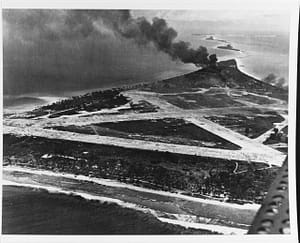
Commander Owen stood up. Pointing at the three runways on the map of Mille Island, he said, “The greatest danger to our Task Group will come if the Japanese are able to use this airfield to receive fighters and bombers from their other airbases.. The destruction of those runways is task number one for VB-5 and VT-5. But gentlemen, it is not your task number one. Remember that! Your priority one is to protect VB-5 and VT-5 from any attack by enemy aircraft. Second, you are to destroy any aircraft in the air or on the ground. I want total air supremacy. Third, having accomplished those two priorities you are free to seek targets of opportunity.”
“VB-5 and VT-5 will orbit at eight angels, twenty miles south of the target. Lieutenants Gray and Gill, your divisions will remain with the bombers, protecting them against any enemy attack. Lieutenant McVay and myself will take our divisions to the target, conduct a fighter sweep, and eliminate all aircraft in the air. When that is complete, I’ll call the bombers in. Gray and Gill, you can bring your divisions in at that time. First priority for all of us at that point is to suppress the ack-ack so the bombers can destroy the airfield. Once the bombers have shot their wad, gentlemen, your fighters can strafe anything that moves or that might be thinking of moving.”
**********
Multi-colored tracers raced up to me as I dove on an antiaircraft battery. At first they seem to float, almost dreamily, but suddenly they zap past my cockpit as though they sped up. I know they were traveling the same velocity all the way up, but the appearance is very deceiving. I had no time to think about it as I pulled the trigger and spat angry lead at the tiny figures shooting at me. They instantly dove for cover. I did not note it consciously at the time, but my mind recorded the image of the body of one of the Japanese being torn to pieces by my bullets.
I pulled out of my dive at about one hundred feet and lined up on another light battery dead ahead. The clatter of bullets striking my fuselage reminded me to start jinking as I raced across the field. I squeezed off a long burst, and then it was up, up, and away. Banking hard, I surveyed the smoking ground below, looking for my next target.
There, under those palm trees! The stiff breeze below was waving that camo netting like a flag. I couldn’t see what was under it, but decided it must be important. I banked hard and put my airship into a twenty-degree dive. Nudging the rudder ever so slightly, the flappy camo net wandered right into my gunsight. I hosed the spot down with a good burst. At first nothing happened, but then I was rewarded with a brilliant, gassy explosion. Banking steeply again I climbed away from the conflagration, trying to avoid the flames. Another massive explosion created a concussion wave that hammered my Hellcat.
“SCARLET-NINE, SCARLET-SIX, SCARLET-THREE, join SCARLET-ONE. SCARLET-FLIGHT, saunter, vector one-seven-oh, five miles, angels three, join up.”
Sounds like its time to go home to CAIRO-BASE. I set my course for one-seven-oh, adjusted my throttle to one-hundred-thirty knots and started a slow climb to three thousand feet, where the squadron would reform before heading back to the carrier.
**********
I stood on the catwalk beneath the bridge. Stars overhead and phosphorescence trailing below comprised the only light. There was no moon yet, and the glow of sunset had long since eased below the western horizon. Lieutenant Bozard stood just a few feet away, also enjoying the peace and the warm breeze.
“Man, it is dark out here,” I said quietly.
“It is that,” he answered.
After a few minutes of silence, I turned to him. “I killed a man today, Boz. Saw it. Maybe several men.”
“Yeah, me too.” He paused, then added, “That’s what war does, Lou. It turns men into killers. Maybe reluctant, regretful killers, but killers nonetheless.”
“I don’t like it. Do you ever get used to it?”
“Well, yes and no, Lou. On the one hand you learn to distance yourself from it. You learn not to think about it, not to dwell on it. You don’t think of the other guy as a human, but only as a target. Your mind forms excuses—well, he was going to kill me, or it’s war, or they started it, or these people are hurting others. You construct all kinds of rationale for what you’re doing—otherwise you go crazy. And it’s not as though your reasons are without merit. They’re actually true. But deep in your heart you know it doesn’t wash the blood off your hands.
“On the other hand, Lou, don’t ever get completely used to it. You don’t want to. At some level the discomfort should remain, must remain, because this war won’t last forever—thank God—and before you know it your sons will be marrying their daughters and their sons will be marrying your daughters.”
We stood silent, listening to swish of the water against the hull as the carrier sailed to tomorrow’s intended launch point.
“You have to do it again tomorrow, Lou.”
I sighed. “I know.”
“Can you?”
I looked up at the starry host above and examined my heart. Finally I answered. “Yes. I can, and I will. But I don’t have to like it.”
Bozard put his hand on my shoulder. “Right answer, Lou. Both parts.” He walked across the catwalk and entered the hatchway, leaving me alone with my thoughts.