


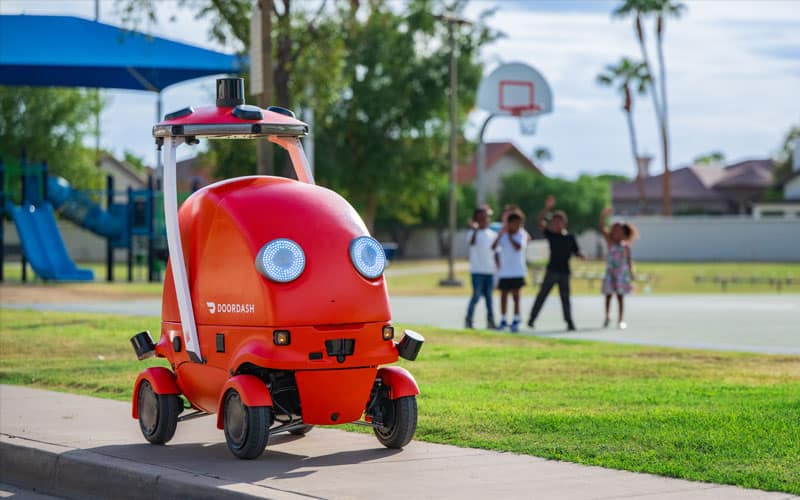
DoorDash has introduced Dot, a brand-new autonomous delivery robot built in-house by its robotics and automation branch, DoorDash Labs. The aim is to make delivery more efficient, sustainable, and flexible—especially for shorter, neighborhood trips.
What is Dot?
-
Size & capacity: About one-tenth the size of a car. It can carry up to 30 pounds of cargo (enough for several food orders).
-
Speed & terrain: It can travel up to 20 miles per hour, navigating bike lanes, sidewalks, roads, and driveways. It’s electric and purpose-built to manage the “last-mile” delivery challenges.
-
Design & user interaction: Dot features sensors (lidar, cameras), LED lights that look like eyes, and greeting animations/phrases (e.g. “Oh, hello!”) to make it friendlier in face-to-face interactions with people.
How It Fits Into DoorDash’s Broader Strategy
Dot is just one component of what DoorDash calls its Autonomous Delivery Platform. This system uses AI to decide, for each delivery, whether it makes sense to send a human driver (“Dasher”), a robot like Dot, or possibly even drones, based on factors like speed, cost, and geography.
The robot program is currently in early deployment in areas around Phoenix (Tempe and Mesa) with plans to expand to more markets.
Potential Benefits & Challenges
Pros:
-
Efficiency gains for short trips where sending a full-sized vehicle is overkill.
-
Reduced emissions, since Dot is electric and smaller than cars.
-
Better capacity management: humans focus on more complex deliveries while robots handle the simpler ones.
Challenges:
-
Regulatory & safety concerns: Using sidewalks, bike lanes, and public roads introduces issues around traffic laws, pedestrian safety, and local regulations.
-
Terrain & infrastructure limitations: Dot can’t handle stairs or elevators, so delivering into some buildings still requires human handoff.
-
Public acceptance & risks: Concerns around vandalism, theft, or how people will interact with or around the robot. Also, whether people will be willing to come out to meet it.
What This Means Moving Forward
Dot represents a shift in how DoorDash sees its role—not just as a marketplace matching customers, restaurants, and delivery people, but as an integrated logistics provider using robotics and AI. If successful, the technology could reshape “last-mile” delivery, making it cheaper, faster, and more sustainable.
Expansion will likely depend on how well Dot performs in real-world settings, how communities accept it, and how local laws adapt. But even in early stages, Dot shows where the industry is headed: more hybrid delivery systems combining humans and machines.