

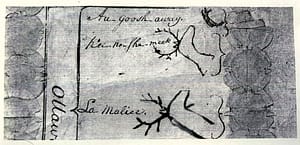
Au-Goosh-away was war chief of the Ottawa Indians in Northern Ohio, Lower Michigan, and Lower Ontario. He fought against Americans in the Battle of Oriskany, almost captured George Rogers Clark near Vincennes, and opposed Daniel Boone at the Battle of Blue Licks. He was the leader of the Northwest Indian Confederacy and took part in the defeat of Harmar, the destruction of St. Clair’s Army, and fought at the Battle of Fallen Timbers, where he was injured in the face. However, Au-Goosh-Away was a better diplomat or civil chief than war chief. He is mentioned in white man’s journals and at treaties as a sensible, considerate man.
He has been neglected in history, possibly because he always used his Indian name, which was recorded in literature phonetically. We are using the spelling that was used on the Treaty of Greenville. Below is a spelling list of his names compiled from British and American manuscripts between 1778 and 1797:
Agashawa Egonshewey Egushewey
Agishua Egouch-a-way Egushiwa
Agoucheway E-gouch-away Egushuvey
Agouchivois Egouch-ouai Egushwai
Aguishere E Gouch-e-ouay Ekushchuwe
Aguishwa Egouchiouois Equochsnay
A-gush-a-wa Egouchiway Equashuvey
A-gush-a-way Egoushaway Equsha
Agushwa Egoushawry Equshawa
Agushway Egoush ouay Equshaway
Au-goosh-away Egoushouay Equshaway
Augushawa Egoushwa Equshiwa
Augushaway Egoushtwa Equshiwa
Augushwa Egush wa Ne-goosh-awat
Au’qu’she’ray Egushawa Negushawa
Gusheways Egushawi Negushway
Egnshewey Egushawe Nigooshiway
Native Americans were emboldened after turning away Harmar’s campaign in two decisive battles. The following year, they destroyed St. Claire’s army at the Wabash. Soon, in November 1791, an Indian council was called on the banks of the Ottawa River to discuss how to proceed to protect the Ohio hunting grounds. The Question was whether we should proceed with peace or war. Au-goosh-away spoke as a war chief. He pointed out that the white man’s word could not be trusted. “Cast your eyes from this council fire to the seacoast. Do you see a single nation of your own color? Their papers, writing, belts, and messages are thrown at you with threats. They invade your country with warriors. Build forts in it without asking or obtaining your leave. They tell you a long story about how they conquered the English, and thereby virtue, they conquered us. So, all lands to the Mississippi belong to them. I tell you, brothers, you have not conquered any of us. I tell you that unless you come to your senses, these rivers must run with blood.”
At this point, a chief advocate of peace spoke. “I acknowledge the truths spoken by my cousin Au-goosh-away. I hope you will excuse me when I tell you, all the injuries and injustice imposed upon you by the United States will not add to your strength, nor lessen the numbers or the power of your oppressors. Your numbers are so few that were you to lose one warrior for each one hundred of theirs, they would extirpate you from your country. Why then strive in vain against the influence of this evil spirit?
It wasn’t until after the Battle of Fallen Timbers, in 1794, that most Native nations decided to give peace a chance. Early in 1795, as Indian Nations gathered for peace talks in Greene Ville, Anthony Wayne noticed Au-goosh-away was not among the chiefs present. He sarcastically remarked, “Perhaps he is angry for the shot he received in his eye. Since he does not come to see me, I’ll go see him.”
However, on July 4th, 1795, Au-goosh-away arrived. With Little Turtle’s encouragement, Wayne held council to see if they should commence with the Treaty. Au-goosh-away stated, “I am much obliged to you for requiring our opinions on this matter. It will be best to remain contented a few days longer.”
Au-goosh-away was one of the four most respected chiefs to sign the treaty. Wayne decided to wait.