


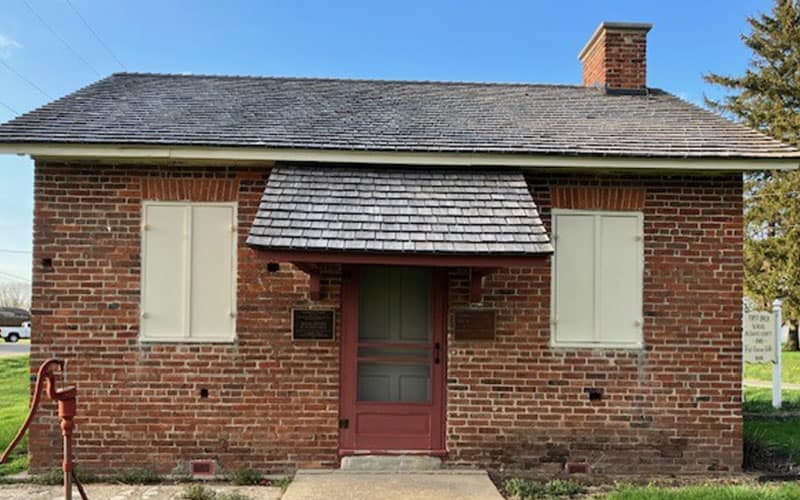
DARKE COUNTY – The Fort GreeneVille Chapter DAR will host an Ohio History Connections Open Doors event on Sunday, September 13, from 2:00 to 4:30 p.m. The community is invited to visit the historic Studabaker Schoolhouse, learn more about its rich history, and help celebrate the importance of preserving this special piece of Darke County heritage for future generations. The chapter is especially pleased to extend a warm invitation to members of the Studabaker family to join us for this special open house and share in the celebration of the schoolhouse’s history and legacy. Light refreshments will be provided.
The historic Studabaker Schoolhouse, located on the former Abraham Studabaker pioneer homestead, has a long and fascinating history that reflects the early days of education in Darke County. Today, the schoolhouse stands as an important local landmark, preserved by the Fort GreeneVille Chapter, Daughters of the American Revolution (DAR), and refurbished to recreate an 1800s classroom.
The story of the school began around 1823, when the first schoolhouse serving the area was a small log cabin located on the old Wyllis Field, just south of the old Arnold Homestead (near the current location). The cabin burned in 1824, and classes were subsequently held in a similar rustic cabin attached to Abraham Studabaker’s home.
Construction of a new brick schoolhouse began around 1838, with the building completed about 1840 on the Studabaker property. Originally referred to as the Beehive School, it was the first brick schoolhouse in Darke County.
In 1869, the schoolhouse was deeded to George Studabaker of the Greenville Township Board of Education. Around that same time, the schoolhouse closed and students were transferred to the Hazel Thicket Schoolhouse (presumed location of the now torn-down
school on Eidson Rd). When Hazel Thicket burned during the holiday season of December 1881 through January 1882, the Studabaker Schoolhouse was once again used for classes until Hazel Thicket was rebuilt.
Around 1888, a new schoolhouse was constructed on Eidson Road. That building became known as the Beehive Schoolhouse, while both it and the Studabaker Schoolhouse were associated with Bee Hive School District No. 14.
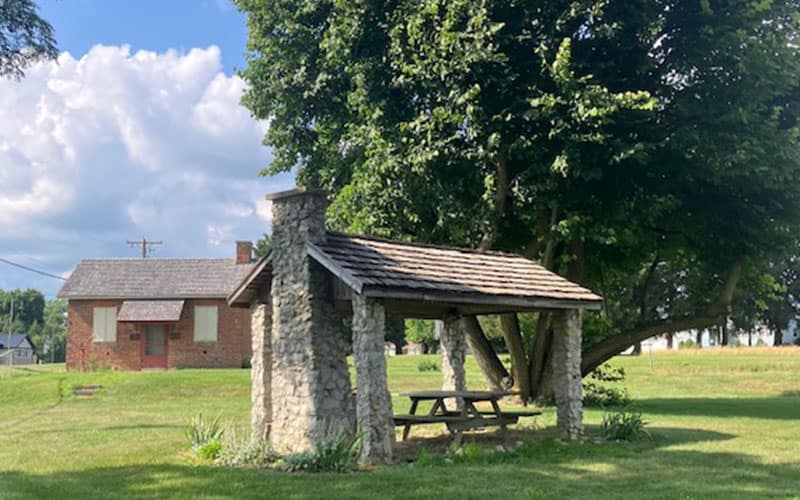
Eventually, the Studabaker Schoolhouse property was returned to the farm from which it had originated and was used for various purposes over the years. In 1934, a nearby road was relocated, leaving the schoolhouse standing on an island of approximately one acre.
That same year, Frank Travis Conkling presented the deed to the Studabaker Schoolhouse to the Fort GreeneVille Chapter DAR. Mrs. Grant, regent of the chapter, received the deed in October 1934, with the formal announcement of the gift made in April 1935. Restoration work by the chapter was completed in 1937. The importance of the schoolhouse was formally recognized when the Studabaker Schoolhouse and Studabaker Homestead were placed on the National Register of Historic Places on June 15, 1978, by the United States Department of the Interior.
In the years following its acquisition, the Fort GreeneVille Chapter periodically held meetings, guest days, class reunions, and picnics at the historic property.
The earliest description of the schoolhouse provides a glimpse into what education was like in the 1800s. The original building had grease paper at the windows to provide light; eventually, glass windows replaced the grease paper. A large open fireplace provided warmth. Benches were built along the walls, with writing desks for students and a desk and bench for the teacher.
Among the earliest teachers associated with the school was George Studabaker, son of Abraham Studabaker. It is believed he may have taught at the schoolhouse bearing his family’s name. Records also note that Conrad Burgner was the first teacher in the partially completed schoolhouse around 1837–1838. Other teachers included Daniel Hewitt, Sanford Harper, Master Jelleff, M. Spayde, J.T. Martz, and David Beers. The last recorded teacher was Helen Plowman in 1882, who later became a member of the Fort GreeneVille Chapter DAR. A teacher’s pay during the period was approximately $10 per month, or payment through a trade of goods or services.
Students learned from books such as Webster’s Spelling Book, the New Testament, The English Reader, and Talbot’s Arithmetic. Schools were typically in session for only about three months during the winter in their early years, eventually expanding to approximately eight months.
Among the students known to have attended the school were George Studabaker, Jacob Martz, and Hugh Dougherty. It has also been said that Annie Oakley attended the school briefly but the only evidence is an invitation to a class reunion. Other students included members of the Studabaker family, Jesse and Henry Arnold, John Spray, John Martz, and children from the Craig, Rush, Miller, House, Stein, Boyer, and Sebring families.
The Studabaker Schoolhouse later became a gathering place for another local organization. The Treaty City Amateur Radio Association (TCARA) held its first meeting at the schoolhouse on May 1, 1953, and used the historic building as its clubhouse for 66 years. The organization celebrated its 100th anniversary at the schoolhouse in 2011 before vacating the building in June 2019.
From a simple log cabin school to Darke County’s first brick schoolhouse, and from a working school to a historic landmark and preserved classroom, the Studabaker Schoolhouse continues to tell the story of education, pioneer life, and the people who helped shape Darke County.
Today, the Studabaker Schoolhouse has been refurbished to recreate an 1800s classroom, allowing visitors to step inside and experience what a rural Darke County school may have looked like more than 185 years ago. The Fort GreeneVille Chapter DAR takes great pride in preserving and maintaining the schoolhouse and its property, ensuring that this important piece of Darke County history can be enjoyed and appreciated by future generations.