


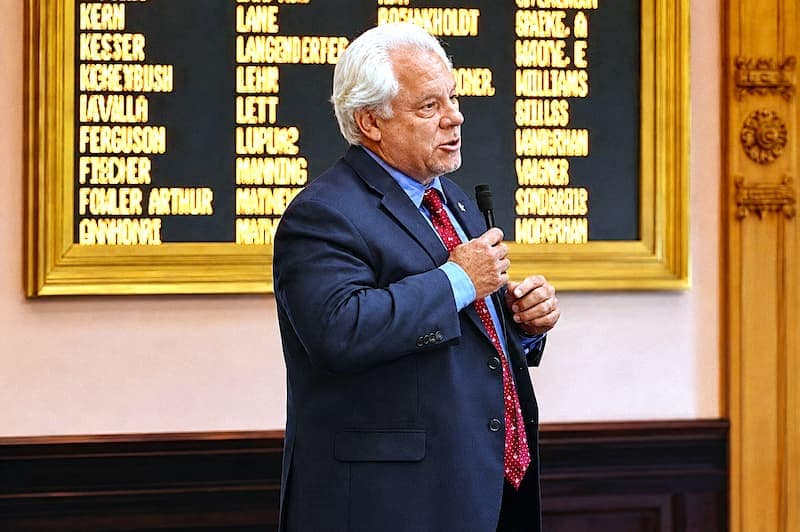
by: State Representative Phil Plummer
Throughout my long law enforcement career, I’ve watched a lot of drug trends come and go. But what I’ve seen with intoxicating hemp products over the past few years is different, and it’s hitting Ohio’s kids harder than almost anything I can remember.
A teenager pulls out a phone, opens a website, clicks a box that says “Yes, I’m 21,” and has hemp-derived THC gummies shipped to their house. No ID check. No verification. No idea what’s actually in the package, because nobody’s testing it. Or they walk into a gas station or vape shop and buy a product in packaging designed to look like Sour Patch Kids or Nerds – products our governor has held up at press conferences to show how brazenly they’re marketed to children. The clerk doesn’t card them. In a sting by the Ohio Department of Public Safety, two 15-year-olds went straight from basketball practice to a Clark County BP and bought delta-8 gummies in under ten minutes, three miles from their school. No one asked for ID.
That isn’t marijuana. Marijuana in Ohio is sold through licensed dispensaries with state-mandated ID checks, lab testing, child-resistant packaging, potency limits, and rules about how far they have to sit from a school. The products causing an increase in emergency room visits and being high at school are hemp-derived THC, manufactured and synthesized in labs from a crop that the 2018 federal Farm Bill legalized for industrial purposes. The intent was for Hemp to be used as a textile, not to chemically convert it into unregulated intoxicating substances.
Lawmakers in Congress never imagined when they wrote that law what it would lead to.
Ohio Poison Control tracked hemp-derived THC exposures among Ohioans 19 and under, doubling from 419 in 2021 to 994 in 2024. Among children five and under, exposures nearly tripled in that same window, from 202 to 555. About 90% of children 12 and under exposed to these products end up in an emergency room. Two-thirds of them require hospitalization. The numbers should scare us all, but what’s even scarier are the calls behind those numbers.
In October 2025, officers at Princeton Middle School in Sharonville responded to multiple students hospitalized after eating hemp-derived THC gummies on school grounds – on two separate days the same week. In April 2026, a Columbus eighth-grader collapsed in class at Champion Middle School after reportedly eating hemp-derived THC gummies; the principal sent a letter home to parents warning of an increase in students bringing intoxicating products into the building. In Northfield, a mother named Charita Shy got a call from her 16-year-old daughter’s friends saying the girl was shaking and vomiting in the car after eating gummies they’d just bought at a gas station.
This is why Governor Mike DeWine spent nearly two years asking the legislature to act, why he eventually declared intoxicating hemp an “adulterated consumer emergency” by executive order in October 2025, and why the legislature passed a bill that pulls them out of gas stations and convenience stores. It’s why Ohio’s medical and law enforcement community testified in support of those changes.
Congress, after years of pressure from state attorneys general, sheriffs, public-health officials, and parents, finally did something. In November, Congress narrowed the definition of hemp to close the loophole that allowed all of this. Even Senator Mitch McConnell – the original author of the 2018 hemp provision – said that his law “sought to create an agricultural hemp industry, not open the door to the sale of unregulated, intoxicating, lab-made, hemp-derived substances with no safety framework.” The fix takes effect on November 12, 2026 but already some members of Congress are trying to open the loophole again, putting an industry over our children.
I want to be clear about something: hemp-derived THC and marijuana are not the same. Forty states, including Ohio, have built regulated cannabis markets with age verification, ID checks, lab testing, and serious packaging rules. That framework works. Officers can enforce it. Retailers know the rules. People know that the product has been tested. The hemp-derived THC market has none of that, by design – and that design is what’s sending Ohio’s children to the hospital.
Ohio’s congressional delegation needs to hold the line. One local congressman, Representative Greg Landsman, sits on the Energy and Commerce Committee, which has direct jurisdiction over the public health consequences of this market, and his current position is a public health issue. He wants to actually protect hemp-derived THC products and the unregulated industry that’s endangering our kids at the federal level.
The hemp industry has every right to work with state governments to create a state-regulated industry, just like every other intoxicating product on the market. However, the hemp industry does not have the right to go unregulated and untested. Anyone wearing a uniform knows that this accident has already caused so much damage: kids’ hospital stays, lost school days, and, in the worst cases, lasting harm to developing brains.
Congress fixed this. Ohio fixed this. Our delegation should make sure it stays fixed.
by: Phil Plummer