


“This your first night launch, Lou?” Lieutenant Bozard asked, as he sat down across from me in the officers’ mess. In another ten minutes we would be piped to the squadron ready room to prepare for a Combat Air Patrol (CAP).
“Yes, sir.”
“Nervous?” he asked.
I thought briefly before answering. “No, not really. Unless we encounter some bogeys, on a CAP there’s nobody shooting at me.”
“You should be.”
“Sir?”
“You should be nervous. It might keep you alive. Listen, Lou, a night launch when the ship is darkened is one of the most dangerous evolutions there is for a carrier pilot. Think about it: there’s no darkness like the darkness in the middle of the ocean on a cloudless, moonless night. The launch itself is not so bad—you can’t see the real horizon, but you can watch your instruments, especially your artificial horizon. As long as you are gaining altitude, you’ll be okay.
“The real trouble comes when you try to join the formation. We can’t use our running lights, because that would give away the carrier’s position if there are jap submarines in the area. So you can’t see the other aircraft. We call it the ‘group grope.’ Collisions are not uncommon.
“I’ll put it this way: this is my second combat tour in the Pacific, Lou. I’ve done many night launches, but I still hate em. I’d rather fly a daylight air strike against stiff enemy opposition than be launched on a CAP at night from a carrier. There are just too many ways it can go belly up when you’re trying to form up a tight formation in absolute darkness. Planes run into each other in the dark. People die. Or sometimes men fly right into the sea because they can’t see the horizon and they’re not looking at their instruments. I’ve seen it many times. Too many times”
“Good grief, Lieutenant! Now I am nervous! Thanks a heap. Is there a solution, Boz?”
“There is. For a safe night launch Lou, you must concentrate on three things. First, you’re launching into blackness—there’s no visible horizon, so keep your eyes glued to the artificial horizon and fly by it. Second, precision flying will go along way to keeping you out of trouble. Stick to your training and to the pre-launch briefing: maintain your airspeed and heading, and your prescribed turn and climb rates. These need to be right on the money. If you do these right, you’ll wind up slightly aft of the formation. Then, third, you watch for the exhaust.”
“Watch for the exhaust?” I asked. “What exhaust?”
“Yeah, the exhaust. The exhaust ports of that eighteen-cylinder beast in a Hellcat give off a faint blue flicker. You can’t see it in the daytime, but you can at night. Watch for the exhaust from the formation and let it to guide you into your spot.”
Bozard grinned at me. “By the way, Cobb, you’re my wingman for this CAP. If you crash into me and we both die, I’m gonna kill you!”
A few minutes later the 1MC directed CAP pilots to the ready room. We all put on red goggles to protect our night vision. After a short intelligence briefing that brought us up to date on all the contacts known to the Combat Information Center (CIC), we exited the ready room through the deck-side hatch. Our plane captains were waiting for us on the flight deck with faintly glowing red wands. Before they guided us to our aircraft, Lieutenant Bozard put his hand on my shoulder.
“Lou, you’ll do fine. Just keep in mind what I told you: watch your artificial horizon, remember your training, watch for the exhaust.”
Thankfully the ceiling was up at fifteen thousand feet, and our formation was rendezvousing at four angels, far below the clouds. Following Lieutenant Bozard’s instructions carefully, soon I could see the exhaust of the formation, and I moved into it right off Bozard’s wing.
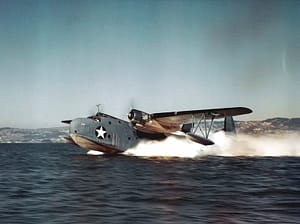
A half-hour later, the Flight Director Officer (FDO) reported that radar picked up a new incoming contact at ten thousand feet. We moved to intercept it, but it turned out to be one of ours—a Martin Mariner, which is a long-range reconnaissance aircraft. He’d been doing some snooping and was headed back to his seaplane tender. Other than that it was a slow night on station. Our hop ended without further incident as the sun was coming up.
**********
The flight quarters bugle sounded over the 1MC, followed by the bosun’s whistle. “Now hear this, now hear this, flight quarters, flight quarters, man all flight quarters stations.”
I looked up from the Acey-Deucy game Andy McClelland and I were playing as we lounged in the ready room, one of the few air-conditioned spaces on the ship. The ready room was a particularly popular spot for pilots on hot, steamy Pacific days. Sometimes our enlisted shipmates would carp about the “coddled pilots.” But then, they weren’t mixing it up with Zeroes or flying into the teeth of anti-aircraft fire, either. We navy pilots liked to think of ourselves as the point of the Pacific spear. If that came with a few special perks, well, all the better.
“That’s odd,” I said, checking my watch. “It will be another hour before they launch the relief for the afternoon CAP. I wonder what’s going on.”
“Let’s go check it out,” McClelland said, standing up
“Sure,” I shrugged. I was losing the game anyway.
We made our way up to Vulture’s Row to see what was happening. Apparently a lot of other guys had the same idea, because it was pretty crowded.
“What’s up?” Andy asked as he crowded to the bulwark so he could see better.
“A couple of pilots from the Liscome Bay can’t find their way home,” replied one of the petty officers just coming off duty in the radio room. “They ran into several heavy squalls returning from a strike and got turned around in the turbulence. It disoriented them and now they’re unsure of the proper heading back to their own carrier. Plus, it’s getting on toward dusk, and they were concerned about finding the Liscome in the dark. So the Lex is taking two, and the other three are landing on us.”
As the three fighters flew past on the downwind leg of the landing pattern, I noticed they were FM-2s. “Hey, those are Wildcats.”
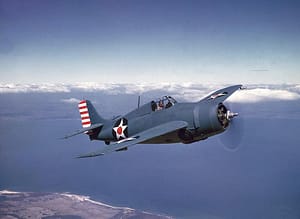
“Yeah,” said Lieutenant Commander Owen, who had also come up to watch the action. “The Liscome Bay, CVE-56, is a baby carrier. All the fighters on her are Wildcats.”
The first guy came in like he was riding on a rail—an absolutely perfect carrier landing. There were murmurs of admiration from the audience on the “Row.” The barrier was lowered swiftly and plane handlers released the tailhook and pushed the Wildcat forward of the barrier. The barrier was immediately raised again and the deck was ready to receive the next aircraft, which was only seconds out.
Landing operations on a carrier resemble nothing so much as a tightly choreographed ballet with split-second timing. Everyone on the flight deck had to perform their part with swift precision. If they didn’t, fatal accidents were not unusual. I had the highest respect for the plane handlers. They had to have eyes in the back of their heads at all times as they walked among spinning propellers, wings being locked into position, moving aircraft, armorers trundling bombs and belly tanks around a crowded deck, and stiff breezes that threatened to blow an unwary man overboard.
The LSO gave the second Wildcat a cut signal, and the fighter hooked the third wire and was yanked to a stop. With flawless teamwork, the plane handlers hustled the aircraft beyond the barrier, and the deck was ready for the third Wildcat.
“Uh-oh,” muttered McClelland, “He’s coming in too hot and his rate of descent is way too steep.”
The LSO waved the pilot off to go around for another approach, but the flier tried to put the Wildcat down anyway. The plane made a hard-wheel landing, and bounced up before the tailhook could snag a wire. Then it sailed over the barrier and collided with two planes spotted on the bow. For maybe five seconds it appeared that any serious injuries had been avoided. The unlucky pilot was clambering out of the cockpit when the avgas gushing from an aircraft he’d collided with ignited in a mighty whoosh of flame. Suddenly two Wildcats and one Hellcat were completely engulfed in flames. I could feel the heat even from up here on Vulture’s Row.
Fifty caliber ammunition in the burning fighters began cooking off and spraying all over the deck, causing the damage control crew on the bow to dive for cover. Under the onslaught they could not employ their fire hoses. But the hoses of the damage control crew at the base of the island—behind the burning aircraft—weren’t long enough to reach the fire. Eventually, heroic action by both the damage control parties and the plane handlers finally got the fire under control as darkness fell. It had taken a full thirty minutes to put the conflagration out, and by this time every submarine within miles could have spotted the Yorktown. Thankfully the wooden flight deck was not badly damaged.
The butcher bill was terrible. The Yorktown lost five brave enlisted men to a wartime accident that should never have happened. Six more were badly injured. The first two Wildcat pilots suffered minor injuries, as well as the pilot responsible for the crash, Lieutenant Blair.
Two of the wrecked FM-2s went “over the transom,” as they say, and two badly damaged Hellcats got the same treatment after they were stripped of useable parts.
**********
Later that evening, all the pilots of VF-5 were piped to the ready room for an informal inquest regarding the fatal accident. I think this is why US Navy fliers are as good as we are: we are committed to learning from our mistakes in order to prevent future ones.
“Lieutenant Blair,” said Commander Crommelin, “this is not a formal disciplinary hearing, nor is it an attempt to establish blame. Perhaps that will come later from your own CAG on the Liscome Bay—it’s not mine to say. In any case, no one here is going to put on record what you say this evening. But we just witnessed a terrible accident that killed five of our crewmen, and I believe it is our job to learn as much as we can from this tragedy so that it never, ever, happens again. Do you understand, Lieutenant?” asked Crommelin, who was himself still recovering from injuries that happened several days prior.
“Yes, Commander. I understand,” responded Lieutenant Blair.
While he tried to maintain a military bearing, the man looked broken to me. I cannot concieve of what he must be feeling and thinking. Not only was he responsible for the needless deaths of five men, he might also be drummed out of the pilot corp because of this accident. To be honest, I felt sorry for him.
“Very well,” nodded Crommelin. “So what happened?”
“It’s actually pretty simple, sir,” Blair said. Looking around the ready room he said, “You boys might remember that the landing gear on a Wildcat is deployed with some thirty turns of a hand crank. You wind it down and it is supposed to latch in place. If it doesn’t latch, and you let go of the crank, it’s going to spin around and break your hand.”
We all nodded, because every pilot in the room had been initially trained on an FM-2 Wildcat. That “feature” of the aircraft was one we all hated. We were well aware of the difficult process to lower the landing gear. One of the great improvements in the Hellcat was the addition of a hydraulic control to raise and lower the landing gear. No more cranking.
“Well,” Blair continued, “mine wouldn’t latch. I was fighting with it to deploy it while in the landing pattern, but it never would lock in the down position. By this time I’m running out of fuel, and I didn’t want to ditch with darkness falling. I allowed the struggle with the landing gear to distract me from landing the airplane. As a result, five men died,” admitted Blair.
I admired the man for his forthright acknowledgment of his mistake. A board of inquiry could conceivably find him guilty for what he just openly admitted.
“Why didn’t you take the wave-off the LSO signalled?” Crommelin asked.
“I was distracted with fighting to get the gear to latch. I thought I was in the groove, and was not watching the LSO in the last second or two of flight.”
“I see. As a lieutenant this must be your, what, second deployment into a combat theater?”
“That is correct, sir. On my first deployment I was flying with VF-6 off the USS Enterprise. I was in the battle of Midway.”
“In other words, in your landing this evening you were ignoring procedures and training that you had mastered at least a year ago.”
Blair hesitated. Finally his head drooped, and he admitted, “Yes, sir.”
“And five men died as a result.”
Blair nodded miserably. “Yes, sir.”
Crommelin let the silence grow until it was uncomfortable even to me, and I wasn’t the guy on the hot seat. The commander scrubbed his face with both hands, and then looked at Lieutenant Blair. “Lieutenant, how long has it been since you landed on a full-size, Essex-class carrier before today?”
“Not since the end of my last deployment. This deployment has been exclusively on Casablanca-class escort carriers.”
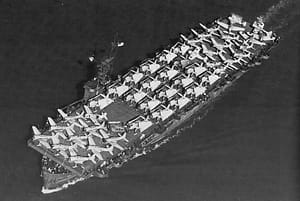
“I see,” said Crommelin again. He thought for a moment before continuing, “Lieutenant Blair, the flight deck of this carrier is 862 feet long. The flight deck of the Liscome Bay is only 477 feet long. Of even greater significance is the difference in the landing area. The distance from fantail to barrier on an escort carrier is about three hundred feet. On an Essex-class it’s five hundred feet.”
Crommelin paused and then asked—or perhaps suggested—I was not sure which: “Is it possible that the much larger flight deck and larger landing space on this carrier made you feel like you had more room for error, perhaps contributing to your lack of attention in the final seconds of flight?”
Crommelin is throwing him a life ring, I thought. And it’s probably legitimate. A longer runway could perhaps make you a tad careless during landing, especially if you were distracted by other problems.
“No, sir. I’m not going to blame the carrier. I did lose concentration in the critical moment of landing, but it was my mistake and my responsibility.”
“I understand that, Blair. But is it a plausible contributing factor? Is it at least possible?”
Blair waited before responding. “Is it possible? Well, yes, I suppose it is theoretically possible, but I’ll not use that as an excuse, sir.”
“Very well. Your mistakes, your failure to follow well-established procedures contributed to the death of five men. It is most regrettable. I can’t say how the Navy will handle this matter. But it is my hope, Lieutenant Blair, that the men who will be placed in position to judge you will remember their own accidents before they make any decision.”
Crommelin then turned to the rest of us in the ready room. “Alright, listen up. I find three lessons we can learn from this. One: in the dangerous environment of an aircraft carrier, a lapse of attention could kill someone. So focus on what you are doing at all times. Two: always communicate with the carrier if there is something about your aircraft that makes a safe landing questionable. Instead of risking the integrity of the flight deck, you might be instructed to ditch or bail out. Three: no matter how many carrier landings you have accumulated, no matter how good you think you are, glue your eyes to the LSO and always, always do exactly what he says—no matter what you might think.”
**********
“Now hear this, now hear this. Darken ship, darken ship. Material condition is Zebra. The smoking lamp is lit. Tonight’s movie on the hangar deck is The Pride of the Yankees, with Gary Cooper and Babe Ruth. The movie will start at three bells. That is all.”
“Isn’t this the third time they’ve shown that flick?” groused Randy Black. Like the rest of us he was stretched out on his rack in his skivvies, trying to stay cool.
There’s nothing quite as hot and humid as being deep in the bowels of a darkened aircraft carrier, packed in with over 3000 other hot, sweaty men, especially when the ship is sailing near the equator. If there aren’t flight operations in process, some guys will stretch out on the flight deck at night just to catch a breeze.
“They’ve shown it at least three times,” said Paul Scheer, lying on his bunk and re-reading the letters he received in this evening’s mail call. “I guess the mail plane didn’t bring any new movies.”
“Didn’t bring any new mail either, at least not for me,” I said.
“Maybe that hot South Carolina honey you’ve been talking about has found a new guy. What’s her name? Helena?” teased Scheer.
“It’s Helen, Dilbert, and I’ve no claim to her. Not yet, anyway. Although I’ve thought about it,” I admitted. “Besides, I got two letters from her last week. Wasn’t expecting any today.”
“Better claim her while you can, Cobb. If the pictures you showed us are for real, she is one swell looking girl,” said Black.
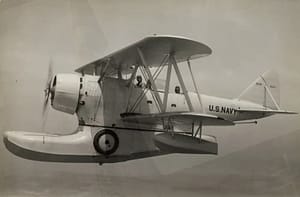
“By the way, guys, isn’t that mail plane one ugly piece of work?” Jim Cole said, chuckling. “It looks like a Piper Cub mated to a canoe. I’d be embarrassed to fly it.”
“You’re saying that the Grumman J2 Duck is an ugly duckling, Jim?” asked Scheer, laughing at his own joke.
“Darn straight.”
“Well, you’d be embarrassed to fly that crate, Jim, but I’ll bet that pilot is the most popular man on the ship. Any pilot or any airplane—no matter how ugly—is first rate in my book if they bring letters from home! And I reckon there are probably about 3000 fellows on the boat tonight that would agree with me.”
A general rumble of agreement rose from all the men in the room.
“Man, it’s hot,” I muttered. “I’m headed for the Gedunk stand for an ice cold coke. Anyone else want to come?”
**********
On 25 November I rolled out of the rack at 0600 hours. I was not scheduled to fly today, so I joined the calisthenics group on the flight deck. This was one of my favorite times of the day. A cool sea breeze was sweeping over the deck, and the horizon was displaying a full pallet of pastel colors. As long as flight operations weren’t occurring, it was a rare, brief snatch of quiet.
After the workout, I was standing with several men on the catwalk enjoying the sunrise. One of the FM pilots from the Liscome Bay was standing with us.
“Lou Cobb,” I said, sticking out my hand to the FM pilot.
“Zach Hancock,” he said, shaking my hand.
“What happened to you guys yesterday?”
“Oh, man. We were flying CAP over Makin when we got attacked by Old Man Weather. A really bad squall got us turned around, and we couldn’t pick up the YE from the Liscome. We were flying circles, trying to find her, and by the time we saw the Yorktown and the Independence, we were running out of both daylight and fuel. You guys appeared at the just right time.”
He paused for a moment, watching a cruiser in the distance, then added, ““I feel awful about the accident yesterday. Lieutenant Blair is an excellent pilot. Has four Zekes to his credit. His landing gear wouldn’t cooperate, and he bungled a landing that ninety-nine times out of one hundred he would have aced. You guys lost five good men because of a terrible accident. It’s tough to lose anyone, but to lose men to an accident rather than to enemy fire—that’s tragic.”
I nodded, but kept my mouth shut. What can you say? Nothing! I can understand the loss of life to an enemy’s guns or bombs, but to an accident? It seems so… pointless, so random.
“I better get my gear,” Hancock said. “We’re flying back to the Liscome this morning.”
At that moment, Lieutenant Commander Owen came up to us. He was now the acting VF-5 squadron leader while Commander Crommelin recovered from his injuries.
“You Hancock?” Owen asked
“Yes, sir?”
“I’m Lieutenant Commander Owen. I’m afraid I have some very bad news for you. We just received notice that the Liscome Bay was torpedoed this morning. She’s gone down with a large loss of life. I’m so sorry.”
Hancock turned pale. “She sank? That quickly?”
Owen nodded. “One of the fish must have penetrated to her magazine. Witnesses said there wasn’t even time to get her damage control parties working. There was a massive explosion. When the smoke cleared she was gone.”
Hancock’s voice trembled, “Is this, is this… certain?”
“I’m afraid so. Captain Clark wants to see you on the bridge, son,” Owen said gently.
When the pilot was gone, Owen turned to us and added, “Apparently it was a horrific nightmare. A witness thinks she was hit by two torpedoes. The first torpedo took out the engine rooms, and the second the magazine. The resulting explosion was massive. Twenty-three minutes after taking the second torpedo there was nothing left on the surface but bodies and smoke. Witnesses on nearby ships saw aircraft, men, and entire deck portions blown two hundred feet into the air. A battleship a mile away was showered with burning deck fragments. We don’t know the casualty count—probably won’t for several weeks—perhaps never.”
Owen added, “By the way, Charlie Crommelin’s brother, John, was on the Bay, chief of staff to Admiral Mullinix. We’ve no word regarding either Crommelin’s or Mullinix’s fate.”
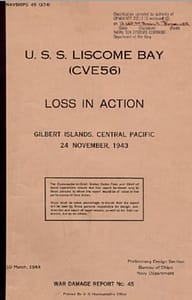
I was learning that sometimes in war you stumble from one horror right into another. An entire ship—perhaps all her crew—just disappeared in twenty-three minutes. The loss of our five men last night due to an accident was terrible. The loss of an entire aircraft carrier and virtually all her crew was unthinkable. I couldn’t wrap my mind around it. War also produces plenty of irony. If those five Wildcat pilots had not landed on the Lex and us last night, they would be dead right now. God alone knows why He traded five lives on the Yorktown to save five lives on the Liscome Bay. It was a mystery I could not penetrate.
Just then, the 1MC sounded and the captain informed the whole crew of what just happened. “This is the captain speaking. We have been notified that the escort carrier Liscome Bay was just sunk with a loss of most, if not all, of her hands. Please pray for the good men lost in this tragedy and their families. As of yet we have no word on the number of survivors. That is all.”
Throughout the rest of the day we were at General Quarters, meaning all hands were at battle stations. The Japs were attacking both us and Task Force 52 numerous times throughout the day. TF-52 was providing air cover for the landings at Makin, and we (TF-50) were intercepting the attackers before they could arrive at the invasion site. But, unfortunately, the Yorktown pilots weren’t assigned to the primary threat axis, so our guys didn’t get in on the hot action. However, between the pilots of the Lexington, the Cowpens, and the pilots of TF-52, at least twenty attackers were splashed at the loss of just one of our fighters. After the loss of Liscome Bay, our dander was up and we were more than ready to rumble. We wanted payback.
Later in the day we learned that Charlie’s brother, Captain John Crommelin, was among the survivors of the Liscome Bay. Admiral Mullinix was not. Apparently Crommelin was in the shower on the Bay when the first torpedo hit. The order to abandon ship was given, so realizing that the ship was doomed, he scrambled up to the flight deck without taking his clothes. The second big explosion blew him off the ship and into the water—in his birthday suit, no less. He was recovered naked as a jaybird, but very happy to be alive.
Sources consulted in addition to Cobb family records and official Navy documents:
Campbell, James H., Lt. Cdr. USNR, Pilots, Man Your Planes, (2000.)
Cox, Samuel J., Director, NHHC, H-025-1: Operation Galvanic—Tarawa and Makin Islands, November, 1943, (2021).
Jensen, Oliver; Lt. USNR, Carrier War, (1945)
Reynolds, Pat., The Yorktown Diary of Ed Reynolds, (2012)