


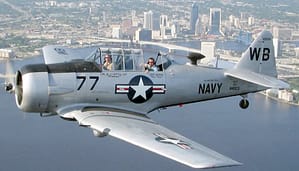
“Put her into an inverted spin,” Lieutenant Hennessy directed.
I rolled the SNJ on to her back, pushed the stick forward to maintain altitude, and reduced power. When the airship began to stall I gave her a little right rudder. The right wing dropped, and I gave her full right rudder, then pushed the stick all the way to the right. She started to spin, so I gave her full power, tightening and increasing the spin.
I looked up—which was actually down, since the plane was upside down—and saw the ground spinning crazily below me as the airplane dropped like a rock.
“Good,” Hennessy said over the intercom. “Nice spin. Now recover before we become a grease spot in somebody’s back yard.”
I cut back the power, centered the stick while pushing it forward, and gave it opposite rudder. When I brought the stick back to a neutral position the nose dropped and the SNJ entered a dive. Having restored aerodynamic control of the airship, pulling out of the dive was a simple matter.
“Well done, Cobb,” said my instructor from the back seat. “I think you’ve got recovery from stalls and spins mastered, so let’s work on acrobatic stunts. Believe it or not, you’ll use ‘em all in combat.”
**********
I had twenty-four hours of liberty, and decided to look up Bill O’Reilly, the Irishman who’d given me a ride to the base when I first arrived at NAS Pensacola. I’d encountered the salty character several times since, and always enjoyed it. I figured he’d be at his usual haunt, Tony’s Diner.
“Well, if it isn’t the man-child pilot,” said Bill O’Reilly as I took a seat at the counter at Tony’s. “You haven’t flunked out yet, have you?”
“Well, well,” I said, matching his sarcastic tone, “if it isn’t that lazy Irish layabout, bummin’ Tony for another free meal.”
O’Reilly grinned and clapped me on the shoulder. “Not bad, kid. You’re learning. If you’re going to survive in this man’s Navy, you gotta be able to take the shots, but you also gotta be able to dish ‘em right back. They must be teaching you somethin’ right.”
“But of course, Mr. O’Reilly, because I’m all grown up now. I’m a whole year older than I was last time you saw me.”
“Shiver me timbers, laddie, so what does that make you? Sixteen?”
“Twenty,” I said, rolling my eyes.
“Twenty,” he scoffed, “why, you’re hardly old enough to drive a car, let alone an airplane. When was your birthday?”
“It’s today, April 15th.”
“TONY,” O’Reilly bellowed, “got a birthday boy here.”
Tony came down the counter, “Who? You, ya lazy mick?”
“Goodness, no, I stopped having birthdays when I retired—didn’t want to get any older. It’s the pup, here.”
Tony looked at me. “Today your birthday for real, kid?”
“Yes, sir”
“How old?”
“Twenty.”
“Still in the service?”
“Yes, sir.”
He nodded. “Meal’s on the house, kid. Happy birthday.”
O’Reilly and I shot the breeze about the weather, fishing, my progress in flight training, and finally turned to talking about the war.
“Sounds like ol’ Montie has the Jerries on the run in North Africa,” O’Reilly said.
“Really? What’s the latest you’ve heard?” I asked as Tony brought me my breakfast.
“Well, you know Rommel’s back in Germany. Von Arnim took over for him—I don’t know who else is heading up the Krauts now in North Africa. But last I heard, Montie’s got ‘em bottled up in Tunisia. It’s just a matter of time now.”
“What about Russia?”
O’Reilly chuckled. “I’ll bet ‘ol Adolf wishes he’d never poked that bear in the eye. He’s lost a lot of men and hardware to the Ruskies. Oh, I’ve heard that Manstein’s on the rampage again. Among all of Hitler’s boot lickers, Manstein is pretty effective. He bagged the Sov’s Third Tank Army a month ago. But after two winters in Russia, I think the Germans are desperate to disengage and back out of the country as quickly as they can. Manstein’s trying to keep a retreat from turning into a rout, from what I hear. Both sides have lost a lot of men, but if it comes down to a war of attrition, the Russians will win. Besides, they have ‘General Winter’ on their side. What have you heard, Lou, from the Pacific theater?”
I sopped up the egg yolk on my plate with a piece of toast. “Well, the Japs have launched a big campaign against Guadalcanal, and they’re conducting raids on New Guinea and Port Moresby. Something like over one hundred fifty aircraft took part in all that action.”
“Yeah, heard that, too.” The Irishman grabbed the carafe and refilled both of our cups. “So, Lou, when you’re done with your training, which theater will you ship out to?”
“Beats me. Wherever they send me, I reckon. If I can cut the mustard, I’ll be a carrier pilot, but I don’t know which ocean I’ll be in.”
**********
When the cadre I was part of graduated from Instrument Flight training into Advanced Flight training at the beginning of April, our squadron designation changed from VN3D8 to VN4D8. I suppose the squadron designation is how the Navy keeps track of the flow and progress of pilots through its training program. Phase A of our training program in VN4 was devoted to evaluating our ability to safely recover from various spins and stalls. There was an ongoing argument in the barracks as to whether the Navy was more concerned about losing an SNJ than it was about losing the cadet pilot if we augured in. Some anonymous wag posted an “official notice” on the barracks bulletin board:
Navy Regulations require that all pilots killed in a crash must return their gear to the base quartermaster prior to burial.
In any case, the whole cadre survived Phase A. Phase B was acrobatics, and I did pretty well in that. The next phase was formation flying and a carrier landing demonstration.
By the end of April of ‘43 I had logged ninety hours of solo flight time and 137 hours total. All the training was paying off. I’d become very comfortable in the cockpit of the SNJ. It was a good thing, too, because in May our daily flying hours shot way up. By the end of the month I’d added seventy-six hours to my solo flight time. On May 6th alone, for instance, I had five hops and logged over five hours of flight time.
**********
As aviation cadets we marched everywhere—in formation, no less. We marched from the barracks to the cafeteria, from the cafeteria to the classroom, from the classroom to the flight line. At least they didn’t make us march to the head.
On the first of May we began the transition to Phase D of our training. We marched to the classroom, where Lieutenant Hennessy was waiting to greet us.
“At ease, cadets. Take your seats. Today your training shifts from teaching you to control your aircraft in all kinds of flying situations, to teaching you how to use that fighter for the purpose it was designed to accomplish. The whole point of a fighter aircraft is to engage and destroy enemy aircraft. Gunnery now becomes the most important part of your training as fighter pilots. Up to this point your training has focused on keeping you safe in the cockpit—taking off, flying, and landing in one piece. You have been taught how to recover from spins and stalls, how to make a dead-stick landing if you lose your engine, how to fly in formation without crashing into the man on your wing.
“But today the focus on your training shifts—it is no longer about keeping you safe—it’s about making things very unsafe for your enemy. It’s about destroying his airplane before he can destroy yours. Now that you know how to fly your airplane, we’re going to teach you how to use it as a weapon of war. You might be the best pilot in the world, but if you can’t shoot worth a plug nickel you won’t make it as a fighter pilot. You’ll have to move to a different specialty, namely scouting, observation, or patrol.
“So today we begin gunnery training. Georges Guynemer was a French ace in the Great War, and he called a fighter plane a ‘flying gun.’ The goal of a fighter pilot is to shoot down the enemy aircraft as quickly as possible, before they shoot you down. Remember—they have guns, too.
“At the moment, the Japanese are flying better hardware than we are. The A6M Zero can fly circles around the Wildcat. There are rumors that the F6F Hellcat will be coming off the production line soon, and that might even the odds. Even so, our boys in the F4F can and do win dogfights with the Japs by flying with superior tactics and superior skill. It’s our job to teach you the tactics and skills of fixed aerial gunnery. It’s your job to master those tactics and skills.”
Hennessy sat on the desk and continued. “When we say we are teaching you how to do fixed aerial gunnery, what we mean is that your machine guns are fixed, stationary, in your fighter. Therefore, you are not aiming the guns so much as you are aiming your airplane. You have to point your aircraft at what you want to shoot. Your enemy doesn’t particularly want to get shot down, so he’ll be taking high-speed evasive action. You must have complete mastery of your fighter in order to follow his movements and put those bullets where they will destroy his airplane.
“There are two crucial elements necessary to master fixed aerial gunnery: the firing approach and the deflection shot. In the firing approach, you are maneuvering your aircraft so as to close on your target with the opportunity for a good shot at close range. It’s a lot harder than it sounds. A deflection shot has to do with how far you lead the target. The amount of lead required will depend on you and your target’s relative headings, your relative speeds, and your distance from the target when you pull the trigger. The hardest part of gunnery to master is the deflection shot in which your initial heading is not parallel to the enemy aircraft’s heading. The concept is simple: you have to lead the enemy aircraft so that he flies right into your bullets. Jimmy Flatly put it this way, “You must shoot at a spot in space which will be full of airplane when your bullets get there.”
“For kicks, let’s put some numbers on this. An airplane flying at 300 mph will travel 440 feet in one second. The muzzle velocity of the F4F machine gun is about 2900 feet per second. Let’s say you’re traveling at 300 mph when you pull the trigger, so the combined speed of your bullets is about 3,350 feet per second. If you take a full deflection shot at a range of 600 feet, the enemy will have traveled seventy-eight feet by the time the bullets arrive. The A6M Zero is roughly thirty feet long. If you lead that target by forty-eight feet it’s a clean miss. Even if you lead him by fifty feet, all you’ll do is poke holes in his vertical stabilizer. For a solid hit, you need to place your bullets seventy-eight feet in front of his cockpit.
“I’m going to turn you boys over to Lieutenant Gray. He’s going to march you out to the skeet range to give you a chance to bust a few clay pigeons. The Navy has discovered that skeet shooting helps you develop the necessary instincts to lead a moving target.”
Lieutenant Gray was older than everyone in our squadron. Gray had flown with Lieutenant Commander Wade McClusky in VF-6 at Midway and had four Zeroes to his credit. VF-6 was approaching legendary status among naval aviators, so we listened intently to whatever this veteran had to say.
“Gentlemen: there are three different kinds of ‘shooting’ for fighter pilots: strafing, air-to-air combat—in other words, dogfighting—and bombing. In strafing and bombing, you’re gunning for a stationary target or one that moves relatively slowly, such as a ship or a vehicle. The air-to-air stuff is a horse of a distinctly different color, and it requires expert control of your aircraft and a natural eye for angles, for leading and shooting when both you and your target are moving at a high-speed.
“How many of you boys have done any bird hunting?” Gray asked. Most of the hands went up. “Uh-huh. Okay, how many of you have actually hit a bird on the wing?” Most of the hands went up again. Gray smirked, “Good. Okay, then, form up, we’re marching to the shooting range to bust a few clay pigeons. We’ll separate the liars from the good shots.”
**********
This I knew how to do. Dad and I have been bird hunting since I was in grade school. He started me with a swell lever-action, single-shot twenty-gauge shotgun, a beautiful gun. He made me carry it unloaded for an entire season until I demonstrated that I’d absorbed the safety lessons he taught me. Whenever we got close to game, he’d give me one shell and let me load the gun.
If I ever swung the muzzle of that gun past him or anyone else he would read me the riot act. Didn’t take me long to learn how to carry that shotgun without endangering anyone.
I was proud of my shooting ability. We didn’t have a lot of money, especially during the Depression, so I had learned to make every shot count. Both for Dad and for me, one shell should produce one bird. That was our standard.
Since my last name begins with a ‘C’, I was third up to the firing line. Rocky Aldridge and John Campbell (the guy who thinks he’s in love with Tokyo Rose) went ahead of me. They both had pretty reasonable scores, Rocky busted fourteen clay pigeons out of twenty-five, Campbell twelve.
Gray handed me the gun, a twelve-gauge pump action with a modified choke, and a box of twenty-five shells. “You know what to do with this thing?” he asked.
“I reckon I do, sir.”
“You’ve hunted before?”
“A bit,” I said. I didn’t want to raise anybody’s expectations, but I knew what I could do.
“Fire at will, cadet.”
I loaded that pump-action with five shells, made sure my squadron mates were behind the safety line, then shouted “PULL!” Took my time, followed that clay pigeon smoothly, then squeezed the trigger. BOOM! That skeet disappeared in a dozen tiny fragments.
“Not bad,” observed Lieutenant Gray.
“PULL!” I shouted. BOOM! Scratch another clay pigeon.
“PULL!” I called. BOOM! Scratch another clay pigeon.
When I was done I’d busted twenty-three of twenty-five clay pigeons and earned the admiration of my squadron mates. Unfortunately, as it turned out, I wasn’t able to duplicate that accuracy in my SNJ. As Gray warned us, gunnery in a fighter was a horse of a different color.
**********
Within a few hops I had strafing down pat. Not so with air-to-air stuff. We were shooting at a big canvas sock towed behind an SNJ on a cable. Over the next week or so we each took a turn towing the target while the rest of the squadron attacked it. Each pilot’s guns were loaded with paint-tipped rounds, so when we were counting the hits after practice, we knew whose they were. It was a lot harder than I thought it would be, and at first my marks were pretty low. It was very discouraging and embarrassing, too, since I’d done so well on the skeet range.
On May 5, for my Period 8 evaluation in Phase C, Lieutenant McNellis wrote: “Circled too wide around objective. Put division in column to attack then was too late to make run. Chased tail instead of making runs on bomber.”
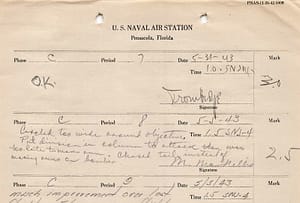
Ouch. That one hurt. My biggest problem with gunnery was not the deflection shot, it was judging the right firing approach. I was having problems putting myself in position to take a shot. At 300 miles per hour, the window for a good shot passed rather quickly, and as Lieutenant McNellis said, if you miss the chance you wind up chasing the tail.
On May 8, Lieutenant Whitney wrote, “Poor runs, too wide starting position” on my evaluation sheet.
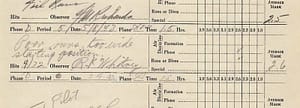
Gradually my scores improved, and my hits on target increased. If I made a good firing approach, I had no problem with the deflection shot. But I was having trouble judging the firing approach. The instructors assured me that part would come with practice and experience. I hoped they were right.
**********
“He’s the Match Stick Marvel,” Bob Wright was saying to Rocky Aldridge as I walked into the barracks. “Or, maybe you could call his tactic the Match Stick miracle.”
“Who? What are you talking about?” I asked. Coming into this conversation late was like hearing only one side of a phone call.
“Lieutenant Commander John Thach. He was CO of Fighting Three at Midway,” Bob replied.
“Heard of him. What’s with the match sticks?”
“According to legend—although I believe it’s probably true—Thach developed new fighter tactics together with his wingman, Ed O’Hare, by pushing match sticks around on his kitchen table.”
“Seriously? Match sticks?”
“That’s what they say. Anyway, he’s had a big impact on fighter tactics and formations, even changing the size of a fighter division and sections. Used to be three fighters in a section: a leader and a wingman on either side. Thach discovered things work better—and safer—with just two fighters in a section, and the wingman stepped down below the leader. It took a while for the Navy come around—Halsey was the holdout—but ComAirBatFor finally approved the change for all the squadrons.
“Thach also invented the Thach Weave, a tactic that accounts for how our inferior F4F Wildcats mauled their superior Zero during the battle of Midway. He calls it the ‘Beam defense’. The formation is a four-plane division composed of two sections flying abreast, the distance between them being the turn radius of the Wildcat. Each section is able to see what’s behind the other section and warn them if attackers are approaching from behind. If one section is jumped by enemy fighters, both sections turn into one another. When it’s done correctly, the section not being attacked will wind up with a perfect firing approach on the Zeroes attacking the other section. Works like a charm—the Match Stick miracle.”
**********
It’s safe to say that nothing I’d experienced in my life challenged me like the training to be a naval aviator. Mastering a large volume of information on your aircraft and all its systems and specifications, learning navigation and the mathematics of vector geometry to calculate proper headings on the fly when encountering a crosswind, absorbing proper radio protocol, becoming skilled in Morse code, and much more created intense pressure on each new squadron of cadets. Add to that the challenge of learning close formation flying, gunnery, night flying, and the knowledge that with a single lapse of attention you could die or be responsible for the death of others—well, it created a pressure cooker that sometimes became tragic.
It was pretty clear that Fred Poole was not going to make the cut. About the only thing he was good at was taxiing and takeoff. Otherwise, Fred found it challenging just to fly a simple coordinated turn without losing altitude or speed. His formation flying was dangerous to anyone in his vicinity. His gunnery scores were terrible, probably because he just couldn’t control his airplane (he wasn’t bad at skeet). The instructors kept him in the program hoping things would finally click for him because America needed pilots, but it became increasingly obvious to us and to Fred that he would not make the grade.
It was May 26. Our squadron was just days from graduation. The late-afternoon mission for the day was navigation over water.
“Gentlemen, there is an oil rig two hundred miles off the coast, right here,” Lieutenant Hennessy said, pointing at a large map of the Gulf. “You will fly formed as a four-plane division out to this rig. When you get there, you will conduct a mock strafing run. Make it look real, being sure to trigger your gun cameras. The oil company has given us permission to do this, so the men on that rig know you’ll be buzzing them today. It’s probably something they are looking forward to, to break up the monotony of the rig.
“The ground crew on the flight line has verified that there is no live ammunition aboard your aircraft, but you are still responsible for double checking. You’ll verify that you have confirmed that your guns are not armed by signing off with your crew chief on the flight line.
“Film your strafing run with your gun cameras, then return here. You are to maintain strict radio silence for the entire flight, communicating with hand signals only.
“You’ll have to plot your flight path using this map. Other than what you’ll need from the tower for takeoff and landing, you will not be given any briefing of the current winds aloft, so you’ll have to estimate it by observation and adjust your heading accordingly. You’ll be hitting that platform just about sunset, which means your return trip will be in the dark. This afternoon’s exercise is designed to give you the opportunity to show us what you have learned about flying in close formation, use of hand signals and radio silence, being stingy with your fuel, navigation over water, strafing a fixed target, night flying, and instrument flight. I’ll see you back here for debriefing in about four hours. Good luck, cadets. That is all.”
For this flight I was the division leader, Fred Poole was my wingman. Rocky Aldridge led the second section, and my buddy Ted Landrum was Rocky’s wingman. Whether or not I was expected to, as the division leader I required that each pilot verify to me that their aircraft had no live ammunition aboard, in addition to their interaction with their crew chief. Once we launched and were all formed up I set a direct course for the oil rig. After we were over water, I studied sailboats tacking and the lay of their sails as well as the set of the chop and wave action on the Gulf. Figuring that I was seeing about a twenty knot wind coming out of the southwest, I made the necessary correction to our heading. Glancing over at Rocky flying on my left, he nodded, indicating agreement with the adjustment.
For about ninety minutes everything went well. The mission profile left us with a fuel reserve of about thirty minutes of flight time. I leaned the fuel mixture for the Pratt and Whitney R-1340 for a little extra insurance, in case our navigation on the return flight wasn’t accurate.
I looked to my right at Fred. He was smiling and waving at me, as though waving goodbye. Seemed odd. I waved back, and suddenly he dropped his nose and headed for the deck.
What? What’s he doing?
The angle of his dive increased until it was near vertical. Confused, I brought the formation around in a tight turn, trying to keep Poole in view. I wondered what had gone wrong with his aircraft. It rapidly became obvious that he wasn’t going to be able to pull out. I prayed that he would bail out—but it didn’t happen.
The plane disintegrated on impact. He must have hit the water at over 400 miles per hour. I knew there was no way he could have survived. I choked down the bile in my throat and led the divisiondown to about three hundred feet. We orbited the spot for a few minutes, hoping against hope to see a life raft. Nothing. Other than a slick from his avgas, there was very little debris on the surface. Fred was gone.
What to do? Rocky and his wingman were still in tight formation with me on my left. For a moment I felt paralyzed with indecision. Then I remembered the lesson our instructors gave us back in February, when Mort Daniels turned too sharply and crashed into Paul Smith—neither pilot survived. Our instructors gave us no room for grief and insisted that the flights for the day must continue without pause. We were told that facing death is part of the package for a naval aviator. It was something we had to accept and move on. We couldn’t allow emotions to take control.
Rocky was asking, via hand signals, if we should break radio silence. I shook my head and pointed up. We ascended to our flight plan altitude and then continued on to the oil rig.
It was pitch black when we landed at NAS Pensacola, but the three of us each greased the landing like we’d flown all our lives. The mission debriefing was difficult. Lieutenant Hennessy praised me for my leadership and the decisions I made to complete the mission, but that did not eliminate the grief that I felt.
The maintenance logs were examined the next day, but they revealed nothing that could explain the malfunction of Fred’s aircraft. The final determination was that the elevator control cable must have parted, making it impossible for Fred to pull up. His death was listed as a training accident.
I asked for and was given the job of putting his personal effects together to send to his folks and to write a personal letter to them. As I was going through his sea bag, I came across an unsealed envelope with a letter inside. I pulled it out, hoping to get the names of family members so that my letter to them would be more personal than a “To Whom it may concern.”
It was a suicide note. Now I understood. There had been no malfunction in Fred’s SNJ. The near vertical dive into the sea was how he determined to deal with the difficulties life had handed to him. I choked back an involuntary groan, and wiped away a few tears. Oh, Fred—why?
I looked around—the barracks was empty, the rest of the squadron was at chow. Taking the letter into the barracks head, I grabbed my lighter, held the letter over the sink and burned it. No one else needed to know—especially not his family.
**********
My last flight as an aviation cadet was on May 30, a 2.6 hour hop as another navigation exercise. I now had 217 hours in the cockpit and had received some of the best flight training available anywhere in the world. I had not yet achieved the level of excellence in flying skills that I wanted—I was rated as average, but I was confident the increased skills would come with experience. On the other hand, I had demonstrated the kind of leadership the Navy was looking for in its officers, a leadership I exercised throughout my naval career.
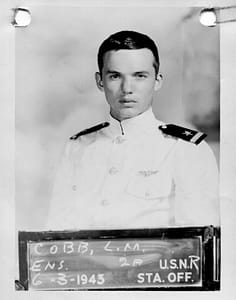
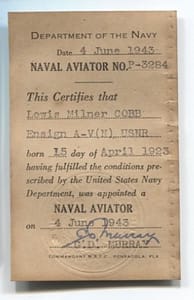
On June 4, I was commissioned as an Ensign and was appointed as a Naval Aviator in the wartime naval reserve. I was now a Navy fighter pilot, headed for carrier training.